Built by Canadians for the world.

Transport & Logistics Marketing That Gets You in Front of Shippers Before the RFP

By the time a shipper sends an RFP to a shortlist of carriers, the decision is largely already made. 81% of B2B buyers have effectively chosen a vendor before ever speaking to a sales representative — they have already Googled your company, evaluated your website, and formed an opinion about your capability.

That pre-purchase research phase is where transport and logistics marketing either wins or loses. Heavy Duty Advertising helps Canadian carriers, freight companies, and logistics providers build the search visibility, digital credibility, and lead generation infrastructure needed to compete for shipper accounts.

1️⃣ Shipper identifies need
2️⃣ Searches Google for carriers
3️⃣ Evaluates websites & reviews
4️⃣ Shortlist set before RFP
5️⃣ RFP issued — too late to get in

Carrier SEO • Lane-Specific Landing Pages • Shipper Lead Generation • Google Ads • Freight Content Marketing • Fleet Account Development • AI Search Visibility

81%
of B2B buyers have chosen a vendor before talking to sales
94%
of B2B buyers use AI tools during vendor research (Forrester 2026)
14–15%
close rate for SEO leads vs 2% for cold outbound calls
5–10
carriers a shipper compares before sending an RFP

Transport and logistics is a B2B market where shippers compare five to ten companies before sending an RFP, and where SEO leads close at 14 to 15 percent compared to just 2 percent for outbound cold calls. The companies that invest in search visibility and content that captures shipper attention during the research phase generate a fundamentally different quality of inbound lead.

Generic B2B marketing approaches miss the specific, high-intent search queries that supply chain managers and transportation procurement teams use when actively evaluating carrier options for new lanes and service requirements.

Shippers are not searching “logistics company near me.” They are searching “temperature-controlled freight Alberta to BC,” “flatbed carrier Western Canada oversized loads,” and “dedicated fleet services Edmonton.” Each of these represents a shipper who has already defined their requirement and is evaluating carriers who can meet it — which is the highest-value buyer moment a transport company can capture through search.

Effective transport and logistics marketing starts with that specificity — building search visibility around the exact lanes, equipment types, load categories, and service capabilities that define your operation rather than generic transportation terms that attract the wrong buyer profile.

Strategic approach

Why Transport and Logistics Companies Need Specialized Digital Marketing

Supply chain manager reviewing carrier proposals and compliance documentation on a laptop at a corporate logistics office
  • Dry Van Truckload
  • Flatbed & Step Deck
  • Temperature-Controlled
  • Tanker & Bulk Liquid
  • Oversize & Overweight
  • LTL & Regional
  • Dedicated Fleet
  • Cross-Border Canada-US
  • Intermodal
  • Specialized Industrial

Content architecture

Build Visibility for Lane-Specific and Service-Specific Searches

Transport and logistics buyers search with operational precision. A supply chain manager sourcing a carrier for a new lane does not search “trucking company” — they search by origin and destination region, by equipment type, by load category, and by compliance and certification requirements relevant to their freight.

Lane-specific and service-specific landing pages are the foundation of search visibility for a transport company. A single generic “services” overview page cannot rank for the range of specific lane and service queries your target shippers use.

  • Dry Van Truckload
  • Flatbed & Step Deck
  • Temperature-Controlled
  • Tanker & Bulk Liquid
  • Oversize & Overweight
  • LTL & Regional
  • Dedicated Fleet
  • Cross-Border Canada-US
  • Intermodal
  • Specialized Industrial

Lane coverage pages targeting specific origin-destination corridors — Alberta to BC, Prairie provinces distribution, Western Canada regional, Trans-Canada truckload — capture shippers who are searching for carrier capability on the specific routes they need covered, not shippers who are browsing generically for transportation options.

Internal linking between service pages, lane pages, and equipment pages builds topical authority — connecting to your heavy duty repair shop marketing and maintenance-related content where relevant to reinforce your fleet reliability and compliance positioning.

Credibility

Digital Credibility — Getting Onto the Shipper Shortlist

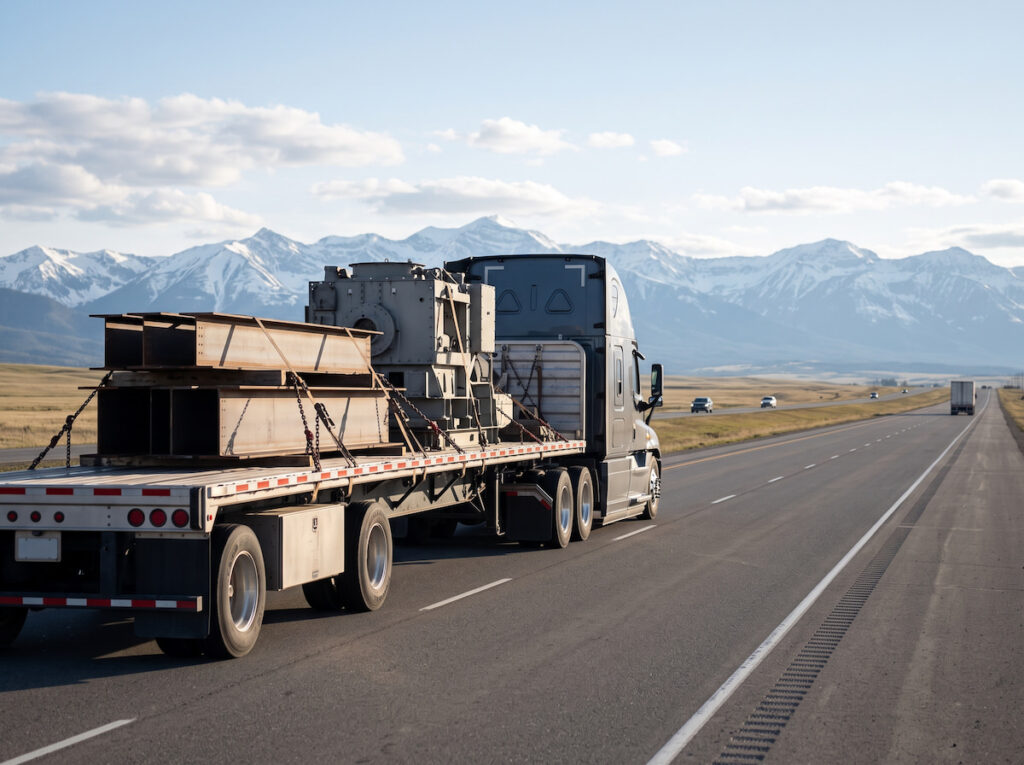
Class 8 semi-truck hauling a flatbed load of industrial steel on a Western Canada highway through a prairie landscape

In the transport and logistics market, a shipper’s research process almost always includes a Google search of your company name after an initial discovery. What they find in that credibility check determines whether your company stays on the shortlist or gets quietly dropped.

A credibility-optimized carrier website gives the evaluating shipper everything they need to verify your company’s capability: fleet specifications and equipment roster with capacity details, operating authority and carrier registration information, safety rating and CVOR standing, insurance coverage levels, service certifications, lane coverage and terminal locations, and case studies or client references from comparable shipper accounts.

Shippers evaluating carriers in 2026 are also increasingly using AI tools to validate vendor shortlists — with 94 percent of B2B buyers now using AI tools like ChatGPT during vendor research. A carrier whose website provides structured, specific, authoritative content is far more likely to be accurately represented in AI-generated vendor summaries than a carrier with sparse or generic web content.

SEO content that addresses real shipper evaluation questions — how your fleet handles temperature excursions, what your on-time delivery performance looks like, how you manage load tracking and shipment visibility — builds the credibility layer that keeps your company on the shortlist through the full evaluation process.

Search & paid

Regional SEO and Google Ads for Shipper Acquisition

Regional SEO for a transport company builds search visibility for the specific geographic combinations your buyers search: provincial and regional freight terms, specific highway corridor coverage, terminal city landing pages, and cross-border service area coverage. A carrier with terminals in Edmonton and Calgary needs individual pages for each terminal city’s freight market — not a single national company page that provides no geographic specificity.

Our diesel shop SEO technical framework provides the structural foundation for this geographic and service-specific content strategy — technically sound page architecture, schema markup for transportation service entities, citation management across freight industry directories and carrier databases, and internal linking that distributes authority across your full lane and service coverage.

Paid search delivers immediate visibility for the highest-intent shipper queries — freight solicitations where a supply chain manager is actively comparing carrier options for a new lane or a service gap. Transport and logistics Google Ads campaigns produce the strongest results when structured around specific lane and service combinations rather than broad transportation terms.

Shipper-intent campaigns built around specific freight categories with dedicated landing pages that provide the specific compliance, equipment, and service information shippers need produce significantly higher quote request conversion rates than generic carrier landing pages that require the visitor to search for relevant information.

According to Google’s B2B advertising resources, multi-touchpoint campaigns combining search visibility with remarketing produce significantly stronger outcomes for B2B service buyers with longer consideration cycles — directly applicable to transport and logistics companies competing for shipper accounts across extended procurement timelines.

A transport company website serves a sophisticated B2B buyer who arrives with specific freight requirements and evaluates your company on your ability to meet those requirements — not on visual design or generic service descriptions.

The most critical website elements for a carrier: services organized by equipment type and service category with individual pages, lane coverage information by region and corridor, fleet specifications and capacity details, compliance documentation including safety ratings, CVOR standing, insurance levels and specialized certifications, shipper references or case studies, a straightforward quote request pathway with freight-relevant fields, and load tracking or shipment visibility information for existing accounts.

Supply chain managers and logistics procurement teams research carrier-relevant topics consistently: how to evaluate carrier safety ratings, what CVOR status means for freight risk, how temperature excursion protocols work, what to look for in a dedicated fleet service agreement, and how to assess carrier on-time performance data.

Service-specific and compliance-specific content positions your company as a technically informed freight partner rather than simply another carrier on a list. For authoritative Canadian freight market context, the Canadian Trucking Alliance publishes ongoing research on carrier market conditions and regulatory developments relevant to shippers evaluating Canadian carrier partners — providing the kind of industry context that supports credible transport and logistics content marketing.

Web presence & content

Website Development and Content Marketing for Carrier Authority

Freight dispatcher coordinating loads at a transport company dispatch centre with dual monitor displays showing route maps and load management

Shipper accounts & automation

Shipper Account Development and Freight Sales Automation

The highest-value shippers for most transport companies are not one-time spot freight customers — they are distribution companies, manufacturers, retailers, and industrial operators with consistent, recurring freight volumes across defined lanes that represent predictable revenue across the full duration of the carrier relationship.

These contract shipper buyers evaluate carriers over extended procurement cycles — comparing five to ten options, conducting carrier audits, reviewing safety and compliance records, and evaluating service performance data before committing to a preferred carrier agreement.

Dedicated shipper account landing pages built around specific freight categories and shipper industry verticals — manufacturing freight, retail distribution, industrial supply chain, food and beverage temperature-controlled logistics — address the specific operational concerns of procurement buyers in each sector rather than presenting generic carrier information.

Our commercial fleet lead generation strategy adapts to the transport and logistics shipper acquisition context — building the content and conversion infrastructure that positions your company in front of the right shipper buyers at the right moment in their procurement research process, and sustaining that visibility across the full evaluation cycle through remarketing and content marketing.

Quote request workflows that acknowledge freight inquiries immediately, confirm the relevant lane and equipment capability, and initiate a structured follow-up sequence convert more inbound leads into active freight discussions than operations that rely on manual response processes with inconsistent follow-up timing.

Resources

Related Services and Industry Resources

For broader context on digital marketing for heavy-duty and commercial transportation businesses, visit the Heavy Duty Advertising home page and our heavy duty repair shop marketing pillar page. For Canadian carrier compliance and market data, the Canadian Trucking Alliance publishes carrier market research and regulatory updates relevant to freight companies. For freight market conditions and trade data relevant to Canadian transport companies, Statistics Canada’s freight transportation survey provides current market intelligence on freight volumes, lane activity, and modal trends.

AI search visibility: 94% of B2B buyers now use AI tools during vendor research. A carrier with structured, specific, authoritative web content is far more likely to be recommended by AI tools than one with sparse or generic content — making content quality a direct pipeline lever in 2026.

Lane pages vs. company pages: “Alberta to BC reefer freight” converts a shipper who has defined their requirement. “Logistics company Canada” converts almost nobody. Build pages for the specific lanes and service combinations your best shippers search for.

Common questions

Transport & Logistics Marketing — FAQ

Does digital marketing work for transport companies, or is freight all relationship-driven?

Both are true — and they reinforce each other. Relationships drive freight contract awards, but every relationship starts with a discovery moment, and increasingly that moment happens through search. A carrier with strong search visibility and a credible digital presence gets into conversations that carriers relying entirely on sales outreach and existing relationships never have access to. SEO leads for carriers close at 14 to 15 percent compared to 2 percent for cold outbound — making inbound search-driven leads measurably more valuable per acquisition dollar.

What types of content produce the most qualified freight leads?

Lane-specific content, compliance and certification explainers, equipment-specific capability pages, and shipper-facing case studies consistently produce the highest-quality freight inquiries. Generic transportation content attracts generic traffic. Content that addresses the specific operational and compliance concerns of a shipper evaluating a particular lane or service category attracts buyers who have already defined their requirement and are actively evaluating carriers who can meet it.

How long does SEO take to produce results for a transport company?

High-intent, long-tail keywords like specific lane and service combinations typically show measurable improvement within 60 to 90 days of a structured SEO strategy. Broader competitive transport terms develop over 3 to 6 months. Content authority and AI search visibility compounds over 12 to 24 months — which is why carriers that start their content marketing strategy earlier develop a compounding advantage over competitors who begin later.

Can Google Ads generate qualified freight leads for a regional carrier?

Yes — when campaigns are structured around specific lane and service queries rather than broad transportation terms. A regional carrier targeting “reefer freight Alberta to BC” or “flatbed oversize Western Canada” reaches shippers who have already defined a specific requirement that the carrier can meet. Budget efficiency matters more than spend volume — a modest daily budget concentrated on high-intent lane and service queries consistently outperforms a larger budget spread across generic transportation terms.

How do you build case studies for shipper accounts that prefer not to be named?

Shipper case studies can be structured around the freight category, the lane or region, the service challenge, the solution deployed, and the measurable outcome — without naming the specific shipper. “Western Canada food manufacturer, temperature-controlled distribution, 3-year dedicated fleet agreement, 99.2% on-time delivery” communicates capability effectively to prospective shipper buyers even without a named reference.

GET STARTED

Grow Your Transport and Logistics Business Online

Shippers are researching carrier options online before they ever issue a freight solicitation. The carriers that appear consistently across the shipper research journey — from early lane and service research through to carrier qualification and compliance verification — get onto shortlists that carriers with weak digital presences never see.

Heavy Duty Advertising can assess your current search visibility for the lane and service queries most relevant to your operation, your website’s credibility and conversion performance, your competitive positioning in your primary freight markets, and your content strategy.

Contact Heavy Duty Advertising to start the conversation.