Built by Canadians for the world.

Construction & Industrial Marketing That Fills Your Project Pipeline Before the Shortlist Is Set

Over 97% of construction and industrial clients research contractors online before making contact. They compare capability statements, check project portfolios, validate certifications, and form a vendor preference — all before a single phone call or RFQ is issued.

The companies that appear consistently throughout that research process get shortlisted. Heavy Duty Advertising helps construction companies, industrial contractors, and commercial service operators build the digital presence needed to compete for high-value project work.

97%
of construction clients research contractors online before contact
3–5×
higher conversion rate for project-specific vs. broad construction keywords
681%
average ROI from organic search for construction and industrial companies
60–90
days to measurable ranking improvement for project-specific keywords

CONSTRUCTION SEO • PROJECT-SPECIFIC LANDING PAGES • GOOGLE ADS • CAPABILITY DOCUMENTATION • SAFETY VISIBILITY • REGIONAL COVERAGE • B2B LEAD GENERATION

Construction and industrial marketing is B2B at its most technically demanding. Your buyers are project managers, procurement officers, facility managers, engineering leads, and development companies who evaluate contractors on capability documentation, safety record, project experience on comparable scope, certifications and bonding capacity, and the credibility signals that tell them your company is qualified to handle their project.

Generic marketing agencies apply consumer-facing frameworks to construction companies — brand awareness campaigns, social media posts, and undifferentiated local SEO that produces visibility without producing qualified project inquiries.

The most consistent failure in construction and industrial marketing is the credibility gap. A project manager receives a referral for your company, searches your name, and finds a website with no project portfolio, no certifications listed, no safety statistics, and no evidence of comparable project experience. That gap ends the conversation before it begins — regardless of how strong the referral was.

Strategic approach

Why Construction and Industrial Companies Need Specialized Digital Marketing

Construction project manager in hard hat and hi-vis vest reviewing project documentation on tablet in front of completed industrial facility

Content architecture

Build Visibility for Project-Specific and Capability-Specific Searches

Construction and industrial buyers search with project precision. They do not search “construction company Alberta” — they search “commercial general contractor Edmonton warehouse,” “industrial plant maintenance turnaround contractor,” or “civil contractor road construction Northern Alberta.” Each query represents a buyer who has defined their project requirement and is evaluating contractors who can meet it.

Service-specific and project-type landing pages are the foundation of search visibility for a construction or industrial company. A single generic company overview page cannot rank for the range of specific project and capability queries your target buyers use.

  • Commercial General Contracting
  • Industrial Construction
  • Civil & Infrastructure
  • Plant Maintenance & Turnarounds
  • Design-Build
  • Steel & Structural
  • Earthworks & Site Prep
  • Mechanical & Millwright
  • Facility Management
  • Electrical Contracting

Geographic pages targeting specific project markets — Edmonton industrial construction, Calgary commercial contracting, Northern Alberta camp and industrial — capture buyers searching for contractor capability in the specific regions where their projects are located.

Internal linking between service pages, project type pages, and geographic coverage pages builds topical authority — connecting to your heavy duty repair shop marketing and related heavy-duty service content where relevant to reinforce your positioning in the commercial vehicle and equipment ecosystem.

Credibility & safety

Local SEO and Google Maps for Towing and Recovery Operators

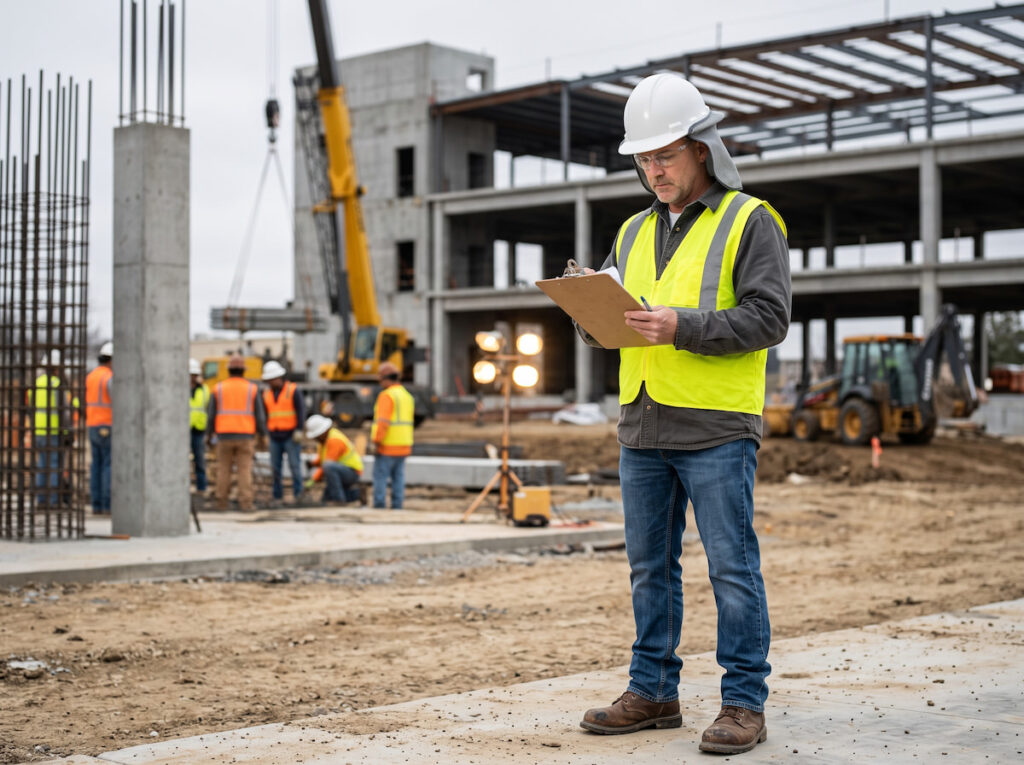
Construction safety officer in full PPE conducting a site inspection with clipboard on an active commercial construction site

A credibility-optimized construction company website gives the evaluating buyer everything they need to verify your company’s capability: your project portfolio with photos and client references from comparable work, your safety statistics, your bonding capacity, your certifications, your equipment list, and your key personnel qualifications.

In the construction and industrial sector, safety record is a mandatory pre-qualification criterion for most significant project opportunities. A company’s TRIF, COR certification status, and safety program maturity are evaluated alongside capability and pricing.

Long-tail construction keywords convert at three to five times the rate of broad terms. A company that appears for “industrial plant shutdown contractor Alberta” in front of a buyer who just issued that search is capturing a prospect at the exact moment of highest purchase intent.

Our commercial fleet lead generation framework adapts to the construction and industrial vendor qualification context — building content and conversion infrastructure that positions your company correctly for formal pre-qualification processes.

Search & paid

Regional SEO and Google Ads for Project Inquiries

Regional SEO for a construction company builds search visibility for the specific project markets where your company competes for work — provincial and regional project markets, specific industrial corridors and resource sector regions, and the sector-specific geographic terms your buyers use when searching for contractors in their project locations.

Our diesel shop SEO technical framework provides the structural foundation for this geographic and capability-specific content strategy — technically sound page architecture, schema markup for construction and industrial service entities, citation management, and internal linking that distributes authority across your full project type and geographic coverage.

Paid search delivers immediate visibility for the highest-intent construction and industrial queries — RFQ solicitations, contractor pre-qualification searches, and project-specific capability searches where a buyer is actively evaluating options and ready to make contact.

Project-intent campaigns built around specific construction categories with dedicated landing pages that provide capability documentation, project experience, and credibility signals buyers need produce significantly higher RFQ and inquiry conversion rates than generic contractor pages.

According to Google’s B2B advertising resources, multi-touchpoint campaigns combining search visibility with remarketing produce significantly stronger outcomes for B2B buyers with longer consideration cycles — directly applicable to construction and industrial companies competing for project work across extended procurement timelines.

A construction or industrial company website is a capability statement as much as it is a marketing tool. Project managers, procurement officers, and development companies arrive at your site with a specific evaluation agenda — and your site either provides the pre-qualification evidence they need or it does not.

The most critical website elements: a clearly organized services section with individual pages for each major service category, a project portfolio with photos and client references, a safety section with your TRIF and COR status, certifications and qualifications, key personnel profiles, and a straightforward contact pathway for RFQ submissions.

Content marketing builds organic search visibility across the full project buyer research journey. Technical content — project capability guides, safety program overviews, equipment and methodology documentation, and project case studies — signals to buyers that your company understands the scope and complexity of the work they need done.

For Canadian construction industry market data and procurement context, the Canadian Construction Association publishes research on construction market conditions and procurement trends relevant to contractors competing for commercial and industrial project work across Canada.

Web presence & content

Website Development and Content Marketing for Construction Authority

Project manager reviewing contractor pre-qualification documents and search results on a laptop in a construction company office

Resources

Related Services and Industry Resources

For broader context on digital marketing for commercial and heavy-duty businesses, visit the Heavy Duty Advertising home page and our heavy duty repair shop marketing pillar page. For Canadian construction industry market data, the Canadian Construction Association publishes research relevant to contractors competing for commercial and industrial project work. For safety certification and COR program information relevant to construction pre-qualification in Western Canada, the Alberta Construction Safety Association is the authoritative resource for COR certification standards.

Project portfolio first: A construction website without a project portfolio is a brochure. Buyers need to see comparable project evidence before they will consider inviting you to bid — a strong portfolio page is your single highest-impact credibility asset.

Safety on page one: Display your COR status, TRIF, and safety program overview above the fold on your homepage and services pages. A procurement manager who confirms your safety credentials before calling has cleared a major pre-qualification hurdle before the conversation begins.

Common questions

Construction & Industrial Marketing — FAQ

Does digital marketing work for construction companies that rely on relationships and referrals?

Yes — and it reinforces rather than replaces those relationships. Every referral now leads to a Google search before the phone call. A construction company with strong search visibility and a credible project portfolio converts those referral visits into contact at a much higher rate than one with a weak or absent online presence. Digital marketing also generates inquiries from buyers who do not yet have a relationship with your company — which is where the highest-value new project work consistently comes from.

What types of content produce the most qualified project inquiries?

Project-specific and capability-specific content consistently produces the highest-quality construction inquiries — detailed project case studies, service pages targeting specific project types and geographic markets, safety and certification documentation, and equipment and methodology content that addresses the pre-qualification criteria buyers apply. Generic construction content attracts generic traffic. Content that addresses the specific capability questions of a buyer evaluating contractors for a defined project attracts prospects who are ready to submit an RFQ.

How long does construction SEO take to produce results?

High-intent, project-specific and location-specific keywords typically show measurable improvement within 60 to 90 days of a structured SEO strategy. Broader competitive construction terms develop over 3 to 6 months. Content authority and project portfolio visibility compounds over 12 to 24 months — which is why construction companies that invest in their digital presence earlier develop a compounding advantage over competitors that rely entirely on word of mouth and existing relationships.

Can Google Ads generate qualified project inquiries for a regional contractor?

Yes — when campaigns are structured around specific project types and capability queries rather than broad construction terms. A regional contractor targeting “industrial maintenance contractor Fort McMurray” or “commercial general contractor warehouse Calgary” reaches buyers who have defined a specific project requirement that the contractor can meet. The lower search volume of specific construction terms is offset by significantly higher conversion rates and project values compared to broad general contractor campaigns.

How do you build case studies for projects where the client prefers not to be named?

Project case studies can be structured around the project type, the scope, the location in general terms, the construction methodology, the safety record, and the measurable outcome — without naming the specific client or project. “Northern Alberta industrial facility expansion — 14,000 sq ft, pre-engineered steel structure, 18-week schedule, COR-certified site, zero lost-time incidents” communicates capability effectively to project buyers even without a named client reference.

GET STARTED

Grow Your Construction and Industrial Business Online

Construction and industrial project buyers are researching contractors online before they ever issue an RFQ or pick up the phone. The companies that appear consistently for the project-specific, capability-specific, and location-specific queries their buyers use get onto shortlists that companies with weak digital presences never see.

Heavy Duty Advertising can assess your current search visibility, your website’s capability documentation, and your competitive positioning — and build a construction and industrial marketing plan around the project pipeline your business wants to grow.

Contact Heavy Duty Advertising to start the conversation.