Built by Canadians for the world.

Towing & Heavy Recovery Marketing That Keeps Your Dispatch Line Busy

When a commercial truck jackknifes on a highway, when a loaded tanker rolls in a ditch, or when a piece of heavy equipment goes off-road on a job site, the call goes to the first heavy recovery operator that appears in search — and it goes fast. Heavy recovery customers are not comparing quotes across five operators. They are calling the first credible result that appears and staying on the phone until someone answers.

That urgency makes towing and heavy recovery one of the most search-intent-driven service businesses that exists. Heavy Duty Advertising helps towing and heavy recovery operators build the search visibility, Google Maps presence, and digital infrastructure needed to capture emergency calls, win motor carrier dispatch contracts, and compete for the commercial recovery work that matters most.

Rotator Service • Heavy Wrecker • Semi-Truck Recovery • Underlift Units • Landoll Transport • Fleet Dispatch • 24-Hour Coverage

HEAVY RECOVERY SEO • GOOGLE MAPS PACK • EMERGENCY CALL CAMPAIGNS • MOTOR CARRIER DISPATCH MARKETING • FLEET CONTRACT DEVELOPMENT • 24-HOUR COVERAGE VISIBILITY

Heavy recovery marketing and light-duty towing marketing share a platform but operate in fundamentally different competitive environments. A light-duty tow truck operator competes with dozens or hundreds of operators in any metro market for high-volume, lower-value consumer calls. A heavy wrecker or rotator operator competes with a handful of qualified operators for lower-volume, significantly higher-value commercial recovery dispatches.

That difference in competitive density and call value changes how marketing should be structured. Light-duty towing rewards raw visibility — appearing for “towing near me” across the widest possible geographic footprint. Heavy recovery rewards credibility and capability signals — appearing for “heavy wrecker service,” “semi-truck recovery,” and “rotator service” with the right certifications, equipment documentation, and trust signals that tell a motor carrier dispatcher your operation is qualified for the job.

A single heavy recovery dispatch can generate $5,000 to $50,000 or more in revenue depending on the complexity of the load, the equipment deployed, and the duration of the operation. A marketing investment that produces one additional heavy recovery call per month pays for itself many times over from a single job.

Effective towing and heavy recovery marketing starts with that distinction — building search visibility around the specific equipment classes, recovery capabilities, and geographic coverage that define your operation, not generic towing terms that attract the wrong caller profile.

Strategic approach

Why Heavy Recovery Marketing Is Different From Light-Duty Towing

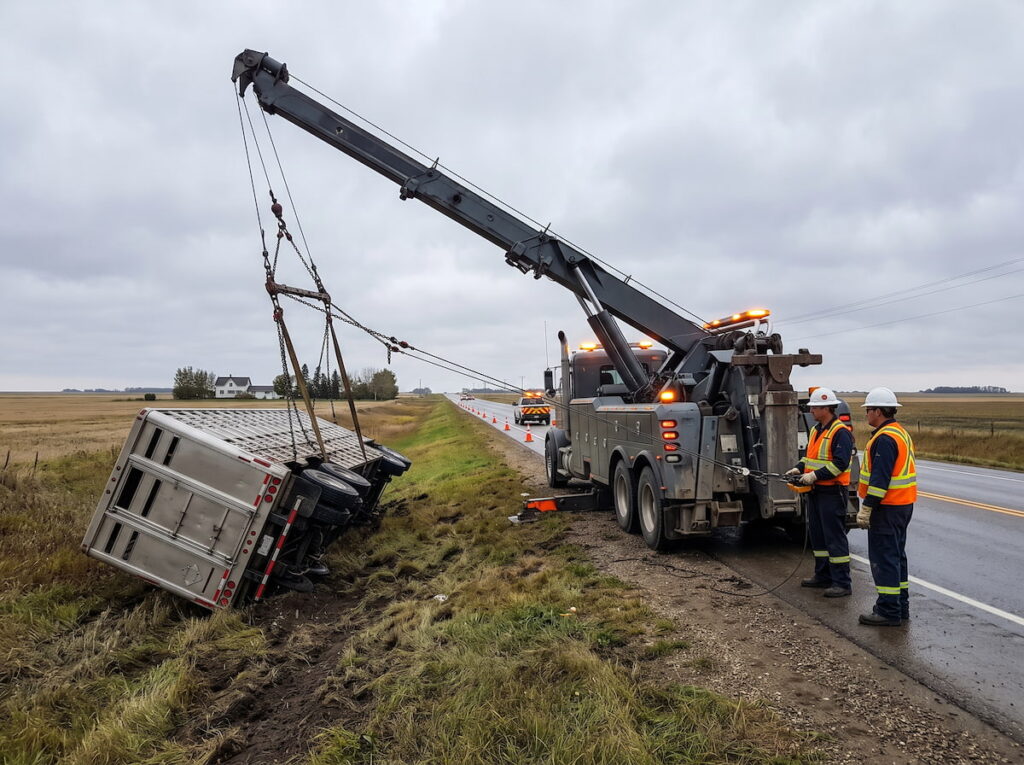
Rotator recovery truck with extended boom rigging an overturned commercial trailer in a highway ditch during a daytime heavy recovery operation

Content architecture

Build Visibility for Heavy Recovery and Commercial Towing Searches

Heavy recovery searches are specific. A motor carrier dispatcher searching for a rotator after a rollover is not typing “tow truck near me” — they are typing “rotator service Alberta,” “heavy wrecker commercial truck rollover,” “semi-truck recovery 24 hours,” or “accident recovery Class 8.” A highway authority or insurance adjuster sourcing a recovery operator is searching for certifications, equipment capacity, and geographic coverage — not proximity alone.

Service-specific and equipment-specific pages built around each recovery category and equipment class your operation runs create independent ranking opportunities for the high-intent queries that produce commercial recovery dispatches. A single generic towing page cannot rank for the range of heavy recovery-specific searches your highest-value callers use.

Pages can be structured around: heavy wrecker service, rotator recovery, semi-truck towing, commercial vehicle accident recovery, equipment recovery, on-site winching and extraction, long-distance heavy haul towing, oversize load recovery, landoll and lowboy transport, fleet towing contracts, impound and storage services, and any specialty recovery categories relevant to your equipment roster.

Geographic coverage pages targeting the specific highway corridors, regions, and communities your equipment serves extend your search visibility beyond a fixed location — capturing dispatchers and fleet operators searching for recovery capability in the territory you actually cover.

Internal linking between service pages, equipment pages, and geographic coverage pages builds topical authority — connecting to your heavy duty repair shop marketing and related heavy-duty service content where relevant to reinforce your positioning as a capable commercial vehicle service partner.

Local search

Local SEO and Google Maps for Towing and Recovery Operators

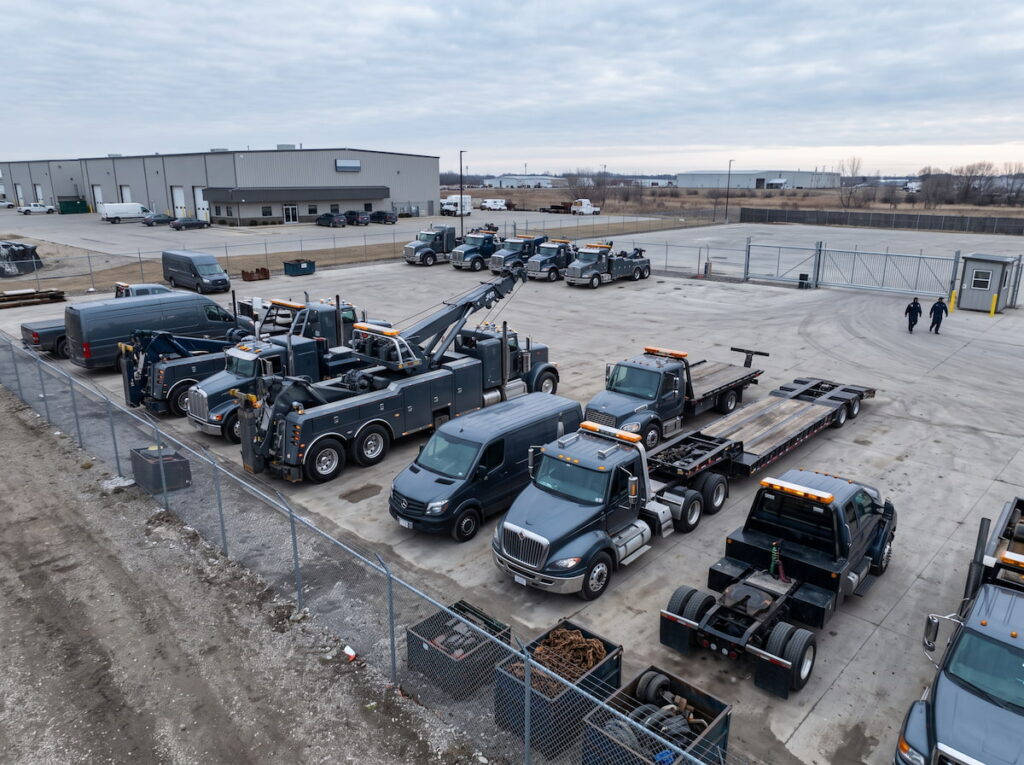
Professional towing and heavy recovery yard with rotator, heavy wrecker and landoll units parked in organized rows at a commercial recovery operation

The Google Maps pack captures more than 60 percent of clicks for location-based towing and recovery searches. In most markets, owning one of the three positions in the Maps pack for heavy recovery queries generates a volume of inbound calls that would cost a competitor $140,000 or more in annual Google Ads spend to replicate. Getting there — and staying there — is the primary objective of local SEO for a towing and recovery operation.

Google Business Profile optimization for a heavy recovery operator involves configuring your listing specifically for commercial vehicle recovery categories — not generic towing or automotive recovery categories that blend your operation in with light-duty consumer towing operators. Your equipment roster, your certifications, your 24-hour availability, your geographic coverage, and your capacity for heavy and complex recoveries need to be communicated through your GBP service listings, your photo documentation, and your review profile.

Photo documentation of your actual equipment — rotators, heavy wreckers, underlift units, landolls, and specialty recovery gear — is a critical credibility signal for commercial dispatchers evaluating recovery operators before making a call.

Our diesel shop SEO technical framework provides the structural foundation — page architecture, schema markup, citation management across towing industry directories and commercial vehicle platforms, and internal linking — that supports sustained local search authority for heavy recovery operations competing across regional highway corridors.

Service-area configuration for a recovery operation that covers a large highway territory needs to reflect the geographic reality of where your equipment operates — not just a radius around your yard. An operator covering 200 kilometres of highway corridor needs search visibility across that entire territory.

Paid search

Google Ads for Emergency Recovery Calls

Paid search delivers immediate visibility for the highest-urgency heavy recovery queries — calls where a motor carrier has a unit off the road, highway access is compromised, and the dispatcher needs a qualified heavy recovery operator answering the phone right now.

Heavy recovery Google Ads campaigns produce the strongest results when structured around the specific equipment classes and recovery scenarios that generate your highest-value dispatches. Campaigns targeting “rotator service semi rollover” or “heavy wrecker accident recovery Alberta” reach a dispatcher who has already identified the nature of the recovery and is looking for a qualified operator.

Call-only campaigns and call extension configurations are particularly important for heavy recovery operators because the conversion event is always a phone call — not a form submission or a website visit. A campaign configured around maximum call volume, with call tracking that records and attributes each call to the specific keyword and campaign that generated it, produces measurably better return than standard click-to-website campaign structures.

According to Google’s Local Services Ads resource centre, proximity-based ad placements with the Google Screened badge — available for verified service businesses — build additional trust signals for urgent service callers evaluating operators in real-time search results, making this ad format particularly valuable for recovery operators competing for high-stakes commercial dispatches.

Geographic targeting for heavy recovery campaigns needs to reflect the highway corridors and regions your equipment can realistically reach — not a standard radius that includes geography your units cannot serve within a reasonable response time window. Overbroad targeting wastes spend on calls your operation cannot respond to competitively.

Emergency calls generate revenue, but fleet dispatch contracts and preferred vendor relationships with motor carriers, transport companies, and highway authorities generate the most predictable and highest-margin work a recovery operation can secure. A transport company that designates your operation as their preferred recovery provider for a regional corridor removes the uncertainty of call-by-call competition and creates a recurring revenue relationship.

Fleet and carrier dispatch buyers evaluate recovery operators on equipment capacity and certification, geographic coverage and response time commitments, 24-hour staffing and availability, driver qualifications and safety program credentials, insurance and liability coverage, and billing and documentation processes. Marketing to these buyers requires a different approach than capturing emergency highway calls.

Dedicated fleet and carrier landing pages address the procurement and operational concerns of motor carrier safety managers directly — with specific information about your equipment capacity, your certifications, your response time commitments, your driver credential standards, and your documentation and billing processes for commercial accounts.

Our commercial fleet lead generation strategy adapts to the heavy recovery context — building the content and conversion infrastructure that positions your operation in front of motor carrier fleet managers and transport company operations teams during the vendor evaluation phase rather than only capturing callers already in an active recovery situation.

Fleet & carrier contracts

Fleet Dispatch and Motor Carrier Contract Marketing

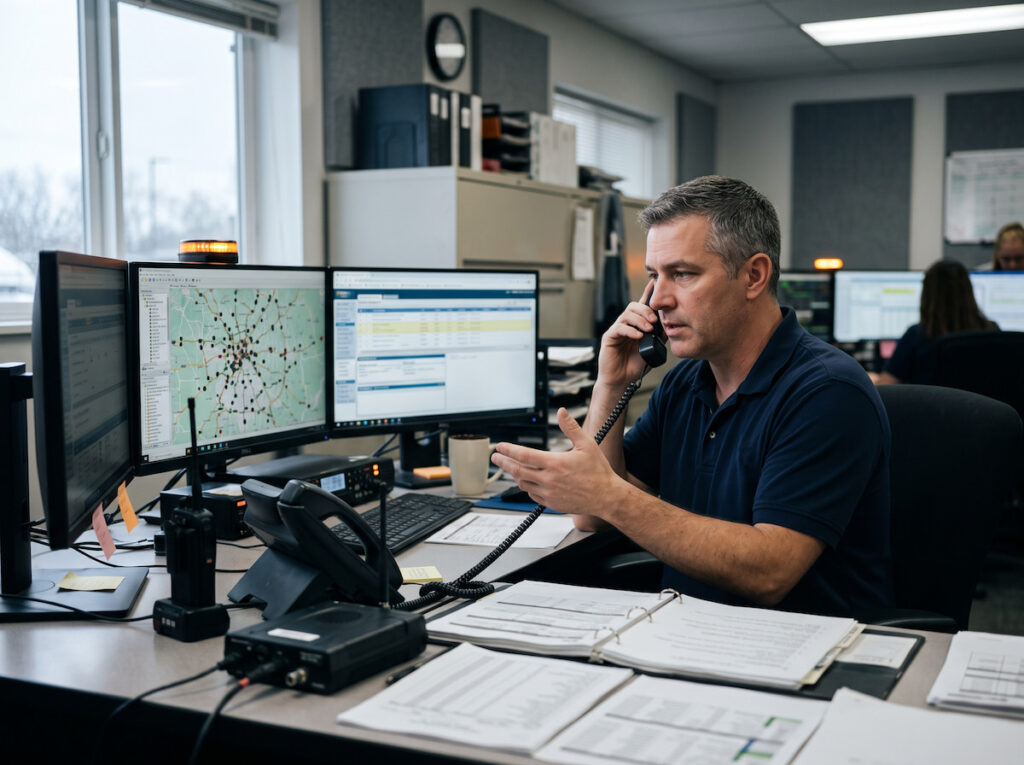
Motor carrier dispatcher managing an active commercial vehicle recovery situation from a professional dispatch centre with monitor displays and communication equipment

Web presence

Website Development for Towing and Heavy Recovery Operations

A heavy recovery operator website serves the same dual-audience challenge as any commercial service operation — the dispatcher in an active emergency who needs to call right now, and the fleet manager evaluating your operation for a dispatch agreement. Both audiences arrive with different needs and different urgency levels.

For emergency callers: your phone number must be visible and tappable at the top of every page — not in a footer, not a contact page, the very top. 24-hour availability, geographic coverage, and equipment capacity visible before any scrolling.

For fleet and carrier buyers: a dedicated commercial services section with equipment roster and specifications, certifications and driver qualifications, geographic coverage map, response time commitments, and insurance and bonding details.

Mobile performance is critical for emergency callers searching from the scene of an incident or from a dispatch centre managing a real-time situation. A site that loads in under three seconds, surfaces your phone number immediately, and clearly communicates your heavy recovery capability before the visitor scrolls captures the call. A slow, cluttered, or hard-to-navigate site loses it to a competitor whose site makes the next step easier.

Recovery scene photos and equipment documentation build immediate credibility for both emergency callers evaluating your capability and fleet managers building a vendor shortlist. Operators whose websites show their actual heavy equipment in active recovery scenarios convert visits into contact at significantly higher rates than operations with generic stock photos or no equipment documentation at all.

Content & reputation

Content Marketing and Reputation Management

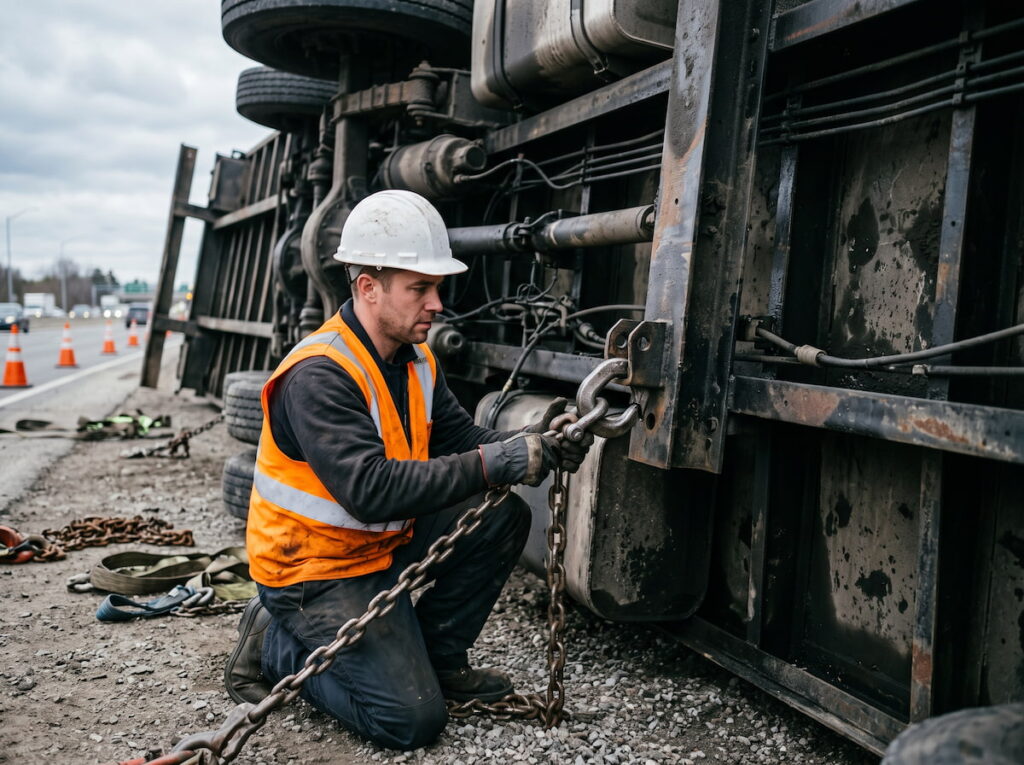
Heavy recovery technician in hi-vis vest and hard hat attaching recovery rigging to the frame of an overturned commercial vehicle at a roadside incident

Motor carrier safety managers, fleet operations teams, and commercial insurance adjusters research heavy recovery topics consistently — how to select a recovery operator for complex commercial vehicle incidents, what certifications qualify an operator for highway heavy recovery, and how to evaluate recovery operator response time and equipment capacity for regional coverage needs.

Technical content — equipment capability guides, recovery scenario overviews, certification explainers, and operational case studies — signals to commercial dispatchers and carrier safety teams that your operation understands the technical demands of heavy recovery at the level they expect from a qualified vendor. Generic towing content that could apply to any operator produces none of this credibility effect.

For regulatory context on commercial vehicle recovery standards and operator certification requirements in Canada, the Canadian Towing Association is the national industry body for professional towing and recovery standards — publishing resources on certification programs, industry regulations, and best practices relevant to operators competing in the commercial heavy recovery space.

Reviews from commercial accounts, carrier safety managers, and insurance adjusters who can speak specifically to your heavy recovery capability and your performance on complex incidents builds the social proof that converts evaluation-stage fleet buyers into contact.

Review response management that acknowledges recovery incidents professionally and confirms your capabilities signals to prospective callers that your operation is active, responsive, and professionally managed.

Resources

Related Services and Industry Resources

For broader context on digital marketing for commercial vehicle and heavy-duty service businesses, visit the Heavy Duty Advertising home page and our heavy duty repair shop marketing pillar page. For professional standards and certification resources for towing and recovery operators in Canada, the Canadian Towing Association publishes industry guidelines and certification program information. For commercial vehicle incident data and highway safety context relevant to fleet and carrier buyers, Transport Canada publishes commercial vehicle safety statistics and highway incident reporting data.

Phone number placement: For heavy recovery, your phone number must be at the absolute top of every page — larger than any other element on the page. A dispatcher managing an active incident will not scroll to find a contact page.

Equipment on your GBP: Upload photos of your actual rotators, heavy wreckers, and underlift units — not stock photos. A dispatcher scanning GBP listings makes a capability judgment in seconds based on what equipment they see in your photos.

Highway corridor pages: A page targeting “heavy recovery Highway 63 Alberta” captures dispatchers searching for coverage in that specific corridor — which a generic location page never will. Build one for each major route you cover.

Common questions

Towing & Heavy Recovery Marketing — FAQ

How is marketing for heavy recovery different from light-duty towing?

Heavy recovery marketing targets a fundamentally different buyer profile. Light-duty towing competes for high-volume consumer calls across a broad geographic footprint. Heavy recovery competes for lower-volume, significantly higher-value commercial dispatches from motor carriers, highway authorities, and commercial fleet operators — buyers who evaluate operators on equipment capacity, certifications, and coverage rather than proximity and price. The keyword targeting, page architecture, and credibility signals required are entirely different.

Can SEO generate fleet dispatch contract leads, not just emergency calls?

Yes — with dedicated carrier and fleet-focused content and landing pages that address motor carrier evaluation criteria rather than emergency caller urgency. Fleet dispatch SEO requires content built around equipment capacity, certification standards, response time commitments, and commercial account terms — not the urgency-driven language that converts emergency callers. Both tracks are achievable from the same website when the architecture is built to serve both audiences separately.

How important is 24-hour availability for heavy recovery marketing?

Critical — and not just operationally. A heavy recovery operation that offers 24-hour availability and communicates that clearly in its GBP, its website, and its ad campaigns captures emergency commercial dispatches that operators without that visibility entirely miss. For highway corridor coverage specifically, 24-hour availability is a baseline requirement for motor carrier dispatch relationships.

Is Google Ads worthwhile for a heavy recovery operator in a smaller regional market?

Yes — and often more effective than in large urban markets where competition is intense. A well-structured campaign targeting heavy recovery queries in a regional highway corridor with limited qualified competition can generate high-value commercial dispatches at a cost-per-call that delivers exceptional return on a relatively modest daily budget.

How do you build case studies for heavy recovery without compromising incident confidentiality?

Recovery case studies can be structured around the equipment deployed, the recovery scenario type, the geographic location in general terms, the complexity and duration of the operation, and the outcome — without identifying the specific carrier, driver, or incident. “Semi-truck rollover recovery, northbound Highway 63, Alberta — 160-ton rotator, 6-hour operation, full lane clearance” communicates capability effectively to commercial buyers without compromising any party’s confidentiality.

GET STARTED

Grow Your Towing and Heavy Recovery Operation Online

Commercial recovery calls go to the operator that appears first with the right capability signals — the right equipment documentation, the right certifications visible, the right geographic coverage communicated, and the right availability confirmed.

Heavy Duty Advertising can assess your current search visibility for heavy recovery queries in your territory, your Google Business Profile configuration for commercial recovery categories, your website’s performance for both emergency callers and fleet account buyers, and your competitive positioning across the highway corridors your equipment covers.

Contact Heavy Duty Advertising to start the conversation.