Built by Canadians for the world.

Commercial Tire Shop Marketing That Fills Bays and Wins Fleet Accounts

Commercial tire buyers operate on two very different clocks. A driver with a blown steer tire on a highway is searching right now — they need a shop that appears immediately, communicates availability clearly, and makes it effortless to call. A fleet manager building a preferred vendor list for 80 units is researching over days or weeks — they need a shop that appears credible, communicates commercial capability, and gives them a reason to shortlist you before they ever pick up the phone.

Both buyer types are searching on Google. Both will choose the shop that appears first with the right signals. Heavy Duty Advertising helps commercial tire shops, heavy-duty tire dealers, and fleet tire service operations build the digital marketing infrastructure to capture both.

Emergency Buyer

Blown tire, needs a shop now — decides in minutes, calls the first credible result

Fleet Buyer

Building a vendor list for 80+ units — evaluates over days, needs a credible commercial partner

Commercial Tire SEO • Emergency Repair Visibility • Google Maps • Fleet Account Marketing • Retread Program Marketing • TPMS Services • 24-Hour Coverage

Most tire shop marketing frameworks are built for consumer retail — passenger vehicles, seasonal changeovers, and promotional pricing. Commercial tire marketing operates in a fundamentally different environment: higher unit values, more technically demanding buyer requirements, stronger urgency signals, and fleet account relationships that represent far more recurring revenue than any single retail transaction.

A marketing strategy built for consumer tire retail will capture some commercial traffic incidentally — but it will consistently miss the fleet manager searching for a preferred vendor, the fleet safety officer evaluating shops for a tire inspection program, and the procurement team building a service agreement for a multi-unit transport operation.

The commercial tire buyer who calls your shop after finding you through a well-optimized Google search is already qualified. They have a specific tire size, a specific axle position, and a specific availability requirement. They are not price shopping across five shops — they are calling the first credible result that appears for their search. Your marketing system needs to make sure that result is you.

Strategic approach

Why Commercial Tire Shops Need a Dedicated Marketing Strategy

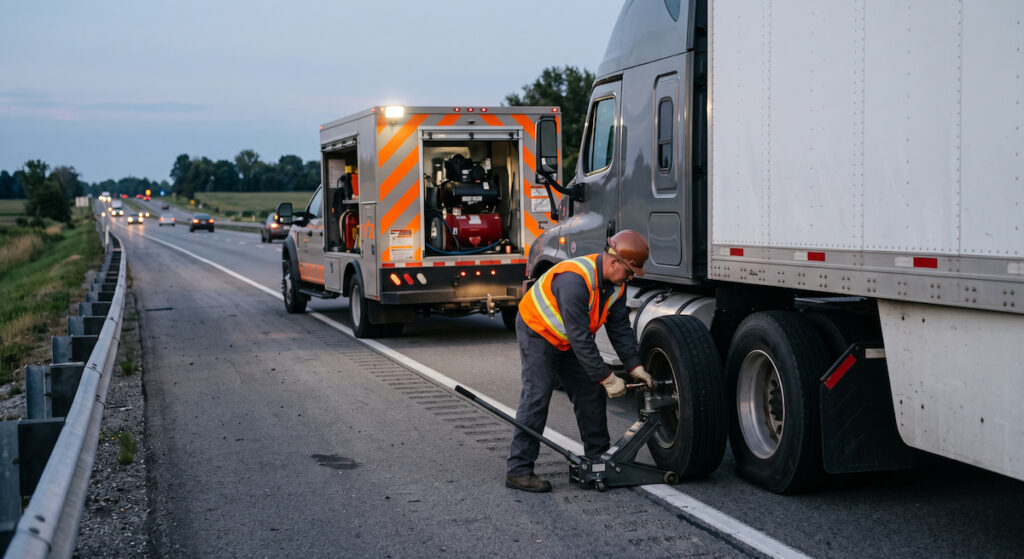
Mobile commercial tire service technician repairing a flat drive tire on a semi-truck pulled over on a highway shoulder

Content architecture

Build Visibility for Commercial Tire-Specific Searches

Commercial tire searches are specific and urgent. A driver with a shredded drive tire is not searching "tire shop" — they are searching "semi-truck tire repair near me," "commercial tire shop open now," or "heavy duty tire service 24 hours." A fleet manager sourcing a preferred vendor is searching "commercial tire shop fleet accounts," "heavy truck tire dealer Edmonton," or "fleet tire maintenance program Alberta."

Service-specific and commercial-category pages built for each tire type, axle position, and service category your shop handles create independent ranking opportunities for the high-intent queries that produce commercial tire inquiries. A single generic tire shop page cannot rank for the range of commercial-specific searches your best customers use.

Pages can be structured around: steer tires, drive tires, trailer tires, super single configurations, wide-base tires, off-road and OTR tires, agricultural tires, emergency roadside tire service, 24-hour commercial tire repair, retread programs, fleet tire management programs, and TPMS service for commercial vehicles.

Within each category, urgency-oriented and fleet-oriented content addresses the two distinct buyer types separately — because the driver who needs a tire right now and the fleet manager evaluating a preferred vendor program are not the same buyer and should not land on the same page.

Internal linking from tire category pages to your heavy duty repair shop marketing and related service content builds topical authority across the full scope of commercial vehicle services your shop provides.

Local search

Local SEO and Google Maps for Commercial Tire Shops

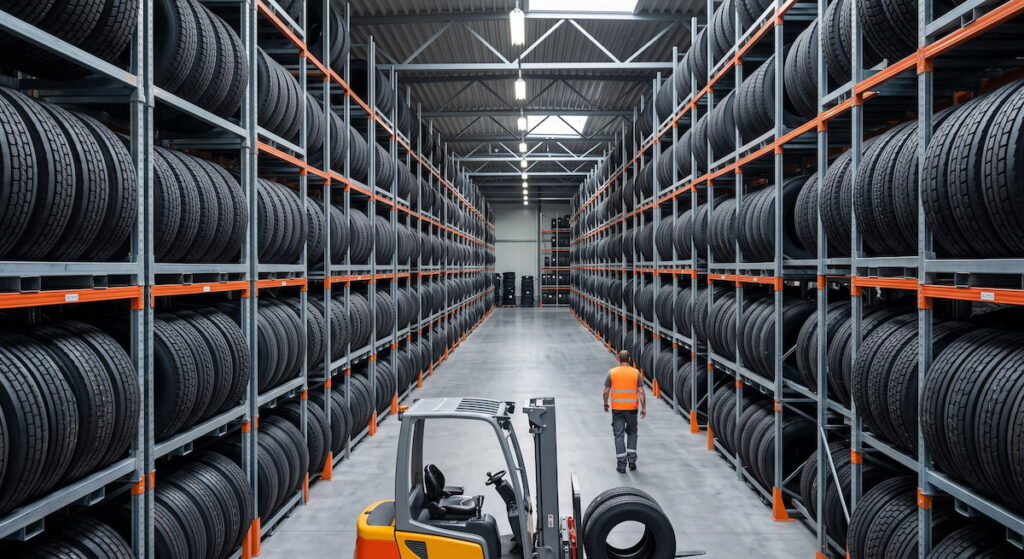
Commercial tire shop inventory warehouse with rows of large truck tires stacked on floor-to-ceiling steel racking

For commercial tire shops, Google Maps is the primary channel for urgent-need customers. A driver with a flat or a blowout searches on their phone, looks at the Maps results for the nearest credible shop, and calls immediately. Appearing in the Maps pack for commercial tire queries — not just generic "tire shop near me" — is one of the highest-value outcomes local SEO can produce.

Google Business Profile optimization for a commercial tire shop involves configuring your listing with commercial vehicle tire categories specifically — not just generic automotive tire retailer categories. Service listings that include semi-truck tires, commercial fleet tires, OTR tires, and 24-hour emergency roadside tire service signal to Google the commercial nature of your operation.

Our diesel shop SEO technical framework provides the foundation — page architecture, schema markup, citation management across commercial vehicle and trucking directories, and internal linking — that supports sustained local search authority for commercial tire operations competing in regional markets.

Seasonal inventory updates matter significantly for commercial tire shops. A shop that actively manages its GBP listings to reflect current commercial tire stock — updating winter commercial tire availability in October, communicating OTR tire inventory for spring construction season — sends Google a current, accurate inventory signal that builds algorithmic trust and improves search ranking over competitors with static, unmanaged profiles.

Paid search

Google Ads for Urgent Commercial Tire Demand

Paid search captures commercial tire buyers at the exact moment of highest urgency — when a driver is stranded, when a fleet has a unit out of service, or when a shop that has not yet built organic rankings needs immediate visibility for high-intent commercial tire queries.

Commercial tire Google Ads campaigns produce the strongest results when structured around the specific urgency signals and commercial intent markers that separate high-value buyers from general tire shoppers. Ad groups targeting "semi-truck tire repair emergency" or "commercial tire shop open now" reach a buyer who is ready to call immediately.

Urgency-oriented campaign extensions — call extensions with your shop's direct phone number, location extensions showing your proximity to major transport routes, and hour-of-day scheduling that reflects when commercial tire emergencies actually occur — convert high-urgency commercial tire searches at significantly better rates than standard campaign configurations.

For shops with mobile tire service units, campaigns can be configured around service-area coverage rather than proximity to a fixed location — reaching drivers who have broken down within your mobile unit's range rather than only buyers searching near your shop address.

According to Google's Local Services Ads resource centre, proximity-based ad placements are particularly effective for urgent service-area businesses — making this ad format especially relevant for commercial tire shops competing for emergency roadside tire calls within a defined geographic territory.

Call tracking connects every phone inquiry back to the specific campaign and keyword that generated it — allowing continuous optimization toward the commercial tire categories and urgency terms producing the highest qualified call volume.

Fleet tire accounts are the most valuable long-term revenue source for most commercial tire shops. A transport company with 60 units, a construction company with a mixed equipment fleet, or a municipal fleet operation with scheduled tire maintenance requirements all represent recurring commercial tire spend that dwarfs the revenue of any comparable number of individual retail transactions.

Fleet tire buyers evaluate vendors on tire brand access and inventory depth, pricing and volume account terms, response time for roadside emergencies, mobile service capability, retread program quality, TPMS service capacity, and the quality of their tire usage and maintenance reporting.

Dedicated fleet tire landing pages address the procurement and operational concerns of fleet managers directly — with specific information about your fleet account program structure, your mobile service coverage, your tire brand partnerships, your retread capabilities, and your reporting and documentation processes.

Our commercial fleet lead generation strategy adapts to the commercial tire context — building the content and conversion infrastructure that positions your shop in front of fleet managers and procurement teams during the vendor evaluation phase rather than only capturing buyers who are already in an emergency.

Converting a single fleet tire account can represent tens of thousands of dollars in annual tire spend from one client — making fleet account marketing one of the highest-return investments a commercial tire shop can make relative to the cost of individual transaction-based advertising.

Fleet accounts

Fleet Tire Account Development

Fleet maintenance manager reviewing a commercial tire program proposal on a laptop in a transport company fleet office

Web presence

Website Development for Commercial Tire Shops

A commercial tire shop website serves two distinct audiences simultaneously — the driver in an emergency who needs to call right now, and the fleet manager who is evaluating your shop for a long-term service agreement. Both audiences arrive with different needs and different evaluation timeframes, and your website needs to serve both without compromising either.

For emergency buyers: click-to-call phone number above the fold, hours of operation including 24-hour service, location and service area, commercial tire inventory depth, and vehicle types serviced — all visible before the visitor scrolls.

For fleet buyers: a dedicated fleet services section, tire brand partnerships and inventory capacity, mobile service unit coverage, retread program details, TPMS service capabilities, and references from recognizable fleet accounts.

Mobile performance is non-negotiable. The majority of urgent commercial tire searches happen on a mobile device — a driver on the side of a highway is not on a desktop. A site that loads in under three seconds on a mobile connection, surfaces your phone number and location immediately, and communicates commercial tire availability without forcing the visitor to navigate multiple pages wins the emergency call.

Content & reputation

Content Marketing and Reputation Management

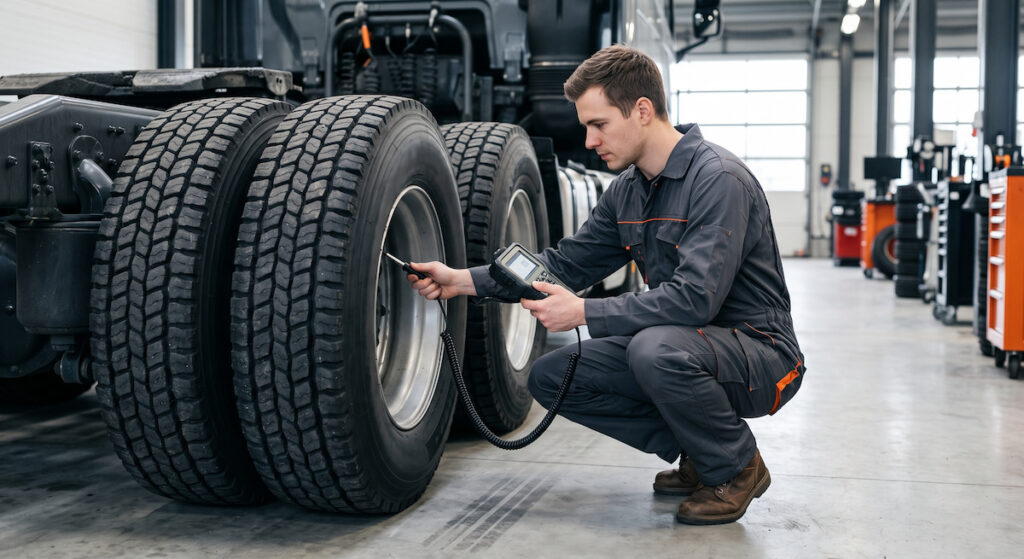
Tire technician using a TPMS diagnostic tool to check tire pressure sensors on the drive axle of a commercial semi-truck

Fleet managers and transport company owners research commercial tire topics consistently — maintenance intervals, retread program economics, TPMS requirements, fleet tire budgeting, premature tire wear causes, and tire selection for specific vocational applications. This content attracts commercial tire buyers at the research phase and builds familiarity with your shop before a purchase need becomes urgent.

Application-specific tire guides — which tire configurations perform best for long-haul versus regional distribution, how OTR tire selection affects equipment operating costs, and what to evaluate when switching commercial tire brands — position your shop as a technically capable advisor rather than simply a transactional tire retailer.

For guidance on commercial tire standards and specifications relevant to Canadian commercial vehicle operations, the Tire and Rubber Association of Canada publishes technical resources on tire standards, retreading programs, and commercial vehicle tire regulations that inform the kind of authoritative content that builds credibility with fleet tire buyers.

Reviews from commercial accounts — fleet operators, transport companies, and equipment owners speaking specifically to your commercial tire capabilities, response time on emergency calls, and fleet account management — build the social proof that converts evaluation-stage fleet buyers into contact.

Review response management that reinforces your commercial capabilities specifically — not generic “thanks for your review” responses — signals to prospective fleet buyers that your shop operates at a commercial service level rather than a retail consumer level.

Resources

Related Services and Industry Resources

For broader context on digital marketing for commercial vehicle service businesses, visit the Heavy Duty Advertising home page and our heavy duty repair shop marketing pillar page. For commercial tire standards and technical resources relevant to Canadian fleet operations, the Tire and Rubber Association of Canada is the authoritative industry body for tire standards and retreading certification. For broader data on commercial vehicle fleet operations in Canada, the Canadian Trucking Alliance publishes fleet statistics relevant to the commercial tire service market.

Two separate buyer paths: Your emergency buyer page and your fleet buyer page should have different H1s, different CTAs, and different conversion pathways. A single page trying to serve both will underperform for both.

Commercial GBP categories: Generic "tire shop" GBP categories miss commercial-specific queries. Configure your listing with semi-truck tire, OTR tire, and fleet tire service categories to capture the right search traffic.

24-hour visibility: If your shop or mobile unit offers after-hours emergency service, that availability must be surfaced in your GBP hours, your ad extensions, and above the fold on your website — not buried in a services page.

Common questions

Commercial Tire Shop Marketing — FAQ

How is marketing for a commercial tire shop different from a consumer tire retailer?

Commercial tire buyers operate on urgency and fleet economics rather than promotional pricing and brand preference. An emergency commercial tire buyer decides in minutes and calls the first credible result they find. A fleet buyer evaluates vendors on inventory depth, mobile service capability, account terms, and retread programs — not on seasonal promotions. A marketing strategy built for consumer tire retail consistently misses both of these commercial buyer types.

Can SEO generate fleet account leads, not just emergency repair calls?

Yes — with dedicated fleet-focused content and landing pages that address fleet manager evaluation criteria rather than emergency buyer urgency. Fleet SEO requires different keyword targeting, different page content, and different conversion pathways than emergency tire repair SEO. Both are achievable from the same website when the architecture is built to serve both buyer types separately.

How important is 24-hour emergency service for commercial tire marketing?

Very important — not only operationally but as a marketing signal. A commercial tire shop that offers 24-hour emergency service and communicates that availability clearly in its GBP, its website, and its ad campaigns captures a significant volume of high-value emergency calls that shops without that visibility entirely miss, even when they offer the same service.

Is Google Ads worthwhile for a commercial tire shop that already gets walk-in traffic?

Yes. Walk-in traffic is geographically limited to drivers who already know your location or happen to pass by. Google Ads captures drivers who are actively searching within your service area — including the high-urgency emergency calls from operators who are broken down nearby and searching for the nearest capable shop. These calls are often the highest-value single transactions a commercial tire shop handles.

How do you market retread programs to fleet accounts specifically?

Retread program marketing targets fleet managers with content and landing pages built around retread economics — the cost-per-mile comparison versus new tires, casing management and inspection processes, retreading standards compliance, and the environmental and operational benefits of a structured retread program. This is distinct from emergency tire marketing and requires a separate content and campaign track.

GET STARTED

Grow Your Commercial Tire Shop Online

Commercial tire buyers are searching right now — some with a blown tire on the side of a highway, others building a vendor list for their fleet's next service agreement.

Heavy Duty Advertising can assess your current search visibility for commercial tire queries in your market, your Google Business Profile configuration, your website's performance for both emergency and fleet buyer audiences, and your competitive positioning.

Contact Heavy Duty Advertising to start the conversation.