

Artificial intelligence isn’t something businesses are simply talking about adopting someday.
According to Apollo’s 2026 AI in Sales & Go-to-Market Survey, which surveyed 328 sales and go-to-market professionals, 97% of teams have already adopted AI in some capacity.
But there’s another statistic buried in the research that may be even more important:
Only 17% say their AI is fully operational.
That’s an important distinction for heavy-duty repair shops, diesel repair businesses, mobile mechanics, fleet service providers and equipment repair companies.
The competitive advantage isn’t simply going to come from “using AI.”
It’s going to come from figuring out where AI can actually make the business better.
AI Isn’t About Replacing Your Staff
There’s a lot of discussion about AI replacing employees.
The data suggests businesses aren’t necessarily looking at it that way.
Despite AI adoption reaching 97%, Apollo reports that only 6% of sales and marketing leaders believe AI could replace someone on their team today.
That’s a very different story.
The opportunity isn’t necessarily replacing your service advisor, salesperson, administrator or marketing person.
It’s helping them accomplish more.
Consider what happens inside a busy heavy-duty repair operation.
The phone rings while someone is dealing with a customer.
A website inquiry comes in after hours.
Someone asks about a CVIP inspection through Facebook.
A fleet manager requests information.
A customer gets an estimate but doesn’t immediately approve it.
Someone calls looking for emergency mobile repair.
A potential commercial customer visits your website and leaves without calling.
None of those opportunities necessarily require another employee.
But they do require a system for making sure opportunities don’t disappear.
That’s where AI and automation can become extremely valuable.
84% Are Already Using AI for Prospecting and Research
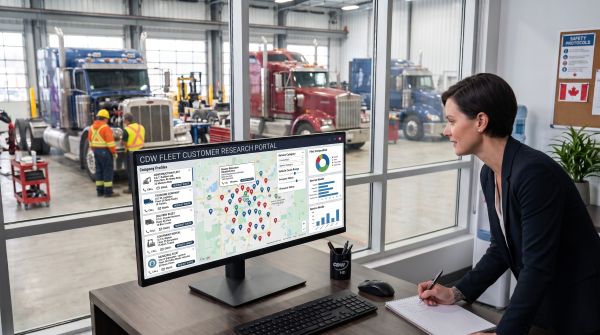
Apollo found that 84% of teams surveyed use AI for prospecting and research, making it the number-one AI use case across every company size surveyed.
That should get the attention of heavy-duty businesses interested in acquiring more commercial accounts.
Think about the companies operating around your shop:
- Trucking companies
- Construction companies
- Oilfield businesses
- Landscaping companies
- Municipal contractors
- Delivery fleets
- Equipment rental companies
- Waste management companies
- Agricultural operations
- Companies operating service vehicles
Instead of waiting for every customer to discover the shop organically, AI-assisted prospecting can help identify potential commercial customers, research their operations and create structured outreach campaigns.
For a heavy-duty repair shop, the objective doesn’t need to be generating hundreds of customers.
One good fleet account could potentially represent dozens of service opportunities over the life of the relationship.
That’s why AI-assisted business development can be particularly interesting for this industry.
66% Are Using AI for Outbound Personalization
Apollo’s research also found that 66% of teams are using AI for outbound personalization.
That’s another area where the technology has changed dramatically.
Traditional cold outreach often looked like this:
Hi, we are a local heavy-duty repair shop. Please contact us if you need service.
AI allows businesses to go much further.
A shop can potentially identify a local construction company, understand the type of equipment or vehicles it operates, determine its service area and create outreach relevant to that particular business.
The technology can assist with the research and preparation.
The human still builds the relationship.
And in an industry where relationships matter, that’s an important distinction.
62% Are Using AI for Lead Enrichment
Another 62% of teams surveyed use AI for lead enrichment.
For a heavy-duty business, this comes back to understanding who is contacting you and what that opportunity might actually be worth.
Imagine two inquiries arrive Monday morning.
One is an individual looking for a relatively small repair.
The second is an operations manager responsible for a fleet of 25 trucks.
They’re both “leads” on a marketing report.
But they’re clearly not the same business opportunity.
Better lead enrichment, tracking and CRM systems can help businesses understand where leads originated, what they’re interested in and which opportunities deserve immediate attention.
The Biggest 2026 Priority? Automation.
Apollo asked respondents about their AI priorities for 2026.
33% ranked automation as their number-one priority — nearly twice the next closest priority.
For heavy-duty businesses, this may be where AI can produce some of its most practical benefits.
Automation can help with activities such as:
Website Lead → Immediate Response
A customer completes a form and receives an immediate acknowledgement rather than waiting until someone checks the inbox.
Missed Call → Follow-Up
Someone calls while the service counter is busy. A follow-up workflow helps prevent the opportunity from disappearing.
Estimate → Follow-Up
An estimate is sent but hasn’t been approved. The system can initiate appropriate follow-up.
Completed Repair → Review Request
The customer receives a review request after service rather than relying on an employee to remember.
Fleet Prospect → Follow-Up Sequence
A prospective commercial customer can be placed into a structured follow-up process.
Old Customer → Reactivation
Past customers can be re-engaged rather than sitting untouched in a database.
AI doesn’t necessarily perform the repair or close the fleet contract.
It helps make sure your people have more opportunities to do so.
But There’s a Warning in the Data
One of the most interesting findings from Apollo’s research is that only 4% of respondents say they fully trust AI output.
That’s important.
AI isn’t a “turn it on and forget about it” solution.
Businesses still need human oversight.
Heavy Duty Advertising takes the same position.
AI can help research, automate, analyze, respond, organize and accelerate work.
But people still need to establish the strategy, monitor the systems and make business decisions.
AI should support your team — not operate your business unsupervised.
More AI Tools Aren’t Necessarily the Answer
Apollo also found that 74% of respondents are already using between two and five AI tools.
Yet two-thirds of the teams surveyed are either still exploring AI or have implemented it without fully optimizing it.
That’s a revealing combination.
Businesses don’t necessarily have a technology shortage.
They have an integration and strategy problem.
Heavy-duty businesses can easily end up with one platform for their website, another for email, another for texting, another for reviews, another for CRM, another for advertising and several different AI tools.
None of them necessarily communicate with each other.
The result can be more technology — but not necessarily a better customer acquisition system.
What an AI-Enabled Heavy-Duty Marketing System Could Look Like
Imagine a potential customer searches Google:
“heavy duty truck repair near me”
They discover your shop.
They visit a service page specifically about the repair they need.
They call.
If the call is missed, a follow-up system responds.
The lead enters your CRM.
Your staff receives the information.
If the customer doesn’t immediately book, an appropriate follow-up process begins.
After the repair is completed, the customer receives a review request.
Meanwhile, your marketing system continues working to help your business appear across Google Search, Google Maps and increasingly AI-powered search experiences.
At the same time, your business development system can help identify potential fleet customers in your market.
That’s much bigger than installing an “AI chatbot.”
It’s building a customer acquisition and follow-up system.
The Competitive Advantage Isn’t AI. It’s Implementation.
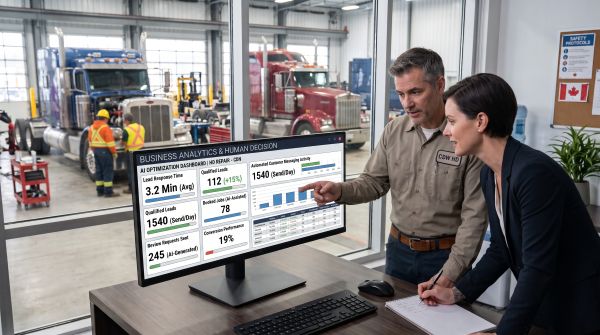
If 97% of sales and marketing teams are already experimenting with AI, simply saying your business “uses AI” doesn’t create much of a competitive advantage.
Execution does.
The real questions for a heavy-duty business in 2026 are:
Are you getting found when customers search?
Are you identifying valuable commercial opportunities?
Are you responding quickly enough?
Are leads being followed up consistently?
Are you building reviews automatically?
Are previous customers being reactivated?
Are your marketing systems actually connected?
Those are business questions.
AI is simply becoming one of the tools available to solve them.
Where Heavy Duty Advertising Fits
At Heavy Duty Advertising, we work specifically with heavy-duty repair, diesel, automotive, equipment and related service businesses.
Our approach combines the pieces that increasingly need to work together:
Google visibility + Local SEO + AI search visibility + paid advertising + lead capture + CRM + automation + reputation + follow-up.
Because getting another 1,000 website visitors isn’t necessarily the objective.
Getting discovered by the right fleet manager, owner-operator, construction company or customer at the right moment is.
And then making sure that opportunity doesn’t fall through the cracks.
Is Your Business Actually Ready for AI?
If you’re running a heavy-duty repair shop, diesel business or equipment service company, you don’t need to implement every AI tool available.
Start with a simpler question:
Where are we currently losing opportunities?
Missed calls?
Slow lead response?
Poor Google visibility?
No fleet prospecting?
No follow-up?
Too few reviews?
Past customers who haven’t heard from you in years?
Those are the places where AI and automation should start.
Heavy Duty Advertising helps heavy-duty businesses identify those gaps and build practical marketing and automation systems around them.
Because AI isn’t about replacing the people who make your business great.
It’s about giving those people a better system to grow the business around them.