

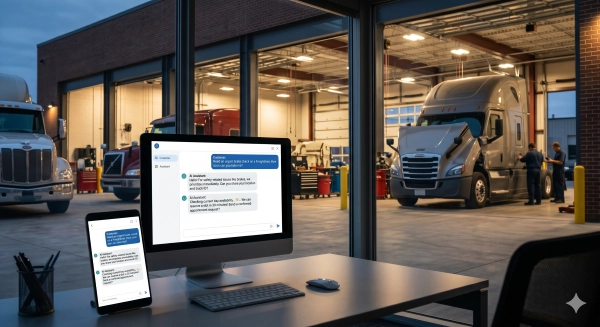
Conversational AI for Heavy-Duty Repair Shops After Hours
Key Takeaways The After-Hours Profit Drain What is Conversational AI? How Conversational AI Transforms Your Shop 1. Instant Engagement 2. Lead Qualification 3. Smart Scheduling...
Get answers to common questions about our digital marketing services for the truck repair industry.
At Heavy Duty Advertising, we specialize in helping truck repair businesses grow through targeted digital marketing strategies. Explore our FAQs to learn how we can support your business and drive measurable results.
Heavy Duty Advertising uses a multi-layered digital marketing approach designed specifically for local Canadian markets. This includes advanced SEO strategies, Google Maps optimization, paid advertising campaigns, social media marketing, and AI-driven automation systems. The goal is to increase visibility in both organic and paid search results while also strengthening brand authority. Local SEO is heavily emphasized to ensure businesses appear in “near me” searches across cities like Edmonton, Calgary, Toronto, and Vancouver. Combined with content marketing and reputation management, these strategies work together to generate consistent traffic, leads, and long-term business growth.
Digital marketing helps increase leads by targeting potential customers who are actively searching for your services online. Through SEO, Google Ads, and optimized landing pages, your business becomes visible at the exact moment customers are ready to buy. For Edmonton-based companies, local SEO ensures your business shows up in map listings and local searches, which significantly boosts inquiries. Social media campaigns and retargeting ads also help bring back visitors who didn’t convert the first time. Over time, this creates a predictable and scalable lead generation system.
Nearly all industries can benefit, but Heavy Duty Advertising sees strong results in service-based and high-competition sectors. This includes construction, automotive services, healthcare, legal firms, real estate, logistics, home improvement, and industrial services. These industries rely heavily on local visibility and trust, making SEO, Google reviews, and paid ads especially powerful. Even e-commerce businesses and startups benefit from structured digital marketing strategies. The systems are adaptable, meaning campaigns are customized based on industry demand, competition level, and customer behavior patterns.
Success is measured using a combination of performance metrics and business outcomes. Key indicators include website traffic, keyword rankings, cost per lead, conversion rates, phone calls, form submissions, and return on ad spend (ROAS). Advanced tracking tools like Google Analytics and conversion tracking systems are used to monitor user behavior. For local businesses, map rankings and call volume are also critical indicators. Ultimately, success is defined not just by traffic growth but by how many qualified leads and paying customers the campaign generates.
Yes, every client receives a fully customized digital marketing strategy tailored to their industry, goals, budget, and competition level. There is no one-size-fits-all approach. The process starts with a detailed audit of the business, followed by competitor analysis and keyword research. Based on this data, a personalized roadmap is created that may include SEO, ads, social media, or automation systems. This ensures that each business gets the most effective combination of strategies to maximize growth and ROI.
Heavy Duty Advertising works across a wide range of platforms to ensure maximum reach and performance. This includes Google (Search, Display, and Maps), Facebook, Instagram, LinkedIn, YouTube, and TikTok depending on the business type. Email marketing platforms and CRM systems are also integrated for lead nurturing. For SEO, tools like Google Search Console and analytics platforms are used. The selection of platforms depends on where the target audience is most active and where conversions are most likely to happen.
Results depend on the strategy used. Paid advertising campaigns like Google Ads and social media ads can generate leads within days or weeks. SEO, on the other hand, typically takes 2 to 4 months to show strong, consistent results, as it builds long-term authority. Local SEO improvements such as Google Maps rankings may start showing progress within a few weeks. The combination of short-term paid strategies and long-term organic growth ensures both immediate and sustainable results for businesses.
Yes, digital marketing is one of the most effective ways for small businesses to compete with larger companies. With targeted SEO, local search optimization, and focused ad campaigns, small businesses can appear alongside or even above big brands in search results. Unlike traditional marketing, digital platforms allow precise targeting, meaning you only reach relevant customers. This levels the playing field significantly and allows smaller companies to attract high-quality leads without needing massive advertising budgets.
A full-service digital marketing package typically includes SEO optimization, website management, Google Ads campaigns, social media marketing, content creation, and reputation management. It may also include email marketing, chatbot automation, and CRM integration depending on the business needs. The goal is to provide an all-in-one solution that handles visibility, lead generation, and customer engagement. Everything is monitored and optimized continuously to ensure maximum performance and consistent business growth.
Local customers are targeted using advanced local SEO techniques, geo-targeted ads, and Google Business Profile optimization. This ensures your business appears when people search for services “near me” or within specific cities like Edmonton or Calgary. Location-based keywords, map listings, and localized content also play a key role. Paid ads can be restricted to specific postal codes or regions to ensure precise targeting. This approach ensures that marketing efforts focus only on high-intent customers in your service area.
Yes, a full digital marketing audit is typically conducted before starting any campaign. This includes reviewing your website performance, SEO status, competitor analysis, keyword rankings, and current advertising efforts. The audit helps identify weaknesses, missed opportunities, and growth potential. It also provides a clear roadmap for improvement. This step ensures that every marketing strategy is built on accurate data rather than assumptions, leading to more effective and measurable results.
Advertising spend is optimized through continuous testing, audience segmentation, and performance tracking. Campaigns are monitored in real time to identify which ads, keywords, and audiences deliver the best results. Poor-performing ads are adjusted or removed, while high-performing ones are scaled. Conversion tracking ensures every dollar spent is tied to measurable outcomes like leads or sales. This data-driven approach helps reduce wasted budget and significantly improves return on investment over time.
The approach is highly data-driven, AI-enhanced, and focused on real business outcomes rather than vanity metrics. Instead of generic strategies, every campaign is customized based on industry, location, and competition. Heavy emphasis is placed on local SEO, conversion tracking, and automation systems that reduce manual work for businesses. Additionally, continuous optimization ensures campaigns improve over time rather than remaining static. This results in more predictable growth and higher ROI compared to traditional agencies.
Yes, digital marketing is one of the most effective ways to increase phone calls and inquiries. Local SEO ensures your business appears in high-intent searches, while Google Ads and call-only campaigns directly encourage phone contact. Optimized landing pages and clear call-to-action buttons also improve conversion rates. Additionally, reputation management builds trust, making customers more likely to reach out. When combined, these strategies significantly increase both inbound calls and online inquiries.
Conversions are tracked using advanced analytics tools such as Google Analytics, conversion tracking pixels, and CRM integrations. Every action—whether it’s a phone call, form submission, purchase, or booking—is recorded and attributed to the correct marketing channel. This allows businesses to clearly see which campaigns are generating real results. Call tracking systems are also used for phone-based businesses. This detailed tracking ensures complete transparency and helps optimize campaigns for maximum performance.
Yes, monthly reporting is a standard part of the digital marketing service. Each report provides a clear breakdown of key performance metrics such as website traffic, keyword rankings, lead generation, conversion rates, ad performance, and ROI. The goal is to give clients full transparency into what is working and what needs improvement. Reports are written in a simple, easy-to-understand format, often supported with visuals and data charts. In addition, strategic insights and recommendations are included so businesses know exactly how their marketing is progressing and what steps will be taken next.
Yes, multi-location digital marketing campaigns are fully supported and commonly used for growing businesses. Each location is treated individually with its own SEO strategy, Google Business Profile optimization, and localized content to ensure maximum visibility in each city. At the same time, all locations are managed under a unified brand strategy to maintain consistency. This approach is especially effective for franchises, service companies, and businesses operating across multiple cities like Edmonton, Calgary, Toronto, and Vancouver. It ensures every branch generates its own leads while strengthening overall brand presence.
The right audience is identified through a combination of market research, keyword analysis, competitor research, and customer behavior data. First, we analyze who is already searching for your services and what terms they use. Then, demographic and geographic data are layered in to refine targeting. For paid campaigns, platforms like Google Ads and Meta Ads provide advanced audience segmentation tools. This ensures ads are shown only to people most likely to convert. Over time, performance data further refines the audience for even better results and lower acquisition costs.
Yes, digital marketing is extremely effective for service-based businesses because most customers search online before making a decision. Whether it’s home services, legal help, healthcare, or repair services, appearing at the top of search results directly influences customer trust and lead generation. Local SEO, Google Ads, and reputation management are especially powerful in this space. These strategies help service businesses capture high-intent customers who are ready to call or book immediately, making digital marketing one of the highest ROI channels for service industries.
Branding plays a critical role in digital marketing success because it builds trust, recognition, and consistency across all platforms. A strong brand identity makes your business more memorable and increases the likelihood that customers will choose you over competitors. In digital marketing, branding includes visual identity, messaging, tone of voice, and online reputation. When combined with SEO and advertising, strong branding improves conversion rates significantly. Customers are more likely to engage with businesses that appear professional, credible, and consistent across websites, ads, and social media.
The website design and development service includes everything needed to create a high-performing, professional website. This typically covers custom design, responsive development, SEO-friendly structure, content layout, speed optimization, and basic on-page SEO setup. Additional features can include lead generation forms, booking systems, e-commerce functionality, and CRM integration. The goal is not just to build a visually appealing website but to create a conversion-focused platform that turns visitors into leads and customers while supporting long-term business growth.
The timeline for building a professional business website usually depends on complexity, features, and content readiness. On average, a standard business website takes between 2 to 6 weeks from planning to launch. More advanced websites with custom features, e-commerce systems, or integrations may take longer. The process includes planning, design, development, revisions, testing, and final deployment. Clear communication and fast client feedback can significantly speed up the timeline while ensuring a high-quality final product.
Yes, all websites are designed to be fully mobile-friendly and responsive by default. This ensures that your website works seamlessly across all devices including smartphones, tablets, and desktops. Mobile optimization is essential because most users now browse and search on mobile devices. Responsive design improves user experience, reduces bounce rates, and also contributes to better SEO rankings. Each layout is tested across multiple screen sizes to ensure consistent performance and usability for every visitor.
Yes, existing websites can be fully redesigned to improve performance, design quality, and conversion rates. The process starts with a detailed audit of your current website to identify issues such as slow loading speed, poor user experience, weak SEO structure, or outdated design. Based on this analysis, a modern redesign is created that improves both appearance and functionality. The goal is not only to make the website look better but also to ensure it generates more leads and performs effectively in search engines.
Conversion optimization is achieved through strategic design, clear calls-to-action, fast loading speed, and user-focused layout structures. Each page is designed to guide visitors toward specific actions such as calling, filling out a form, or making a purchase. Trust signals like reviews, testimonials, and certifications are also included to increase credibility. A/B testing and behavior tracking tools may be used to refine performance over time. The ultimate goal is to turn website traffic into measurable business results.
Yes, e-commerce websites are fully supported and built to help businesses sell products or services online efficiently. These websites include product pages, shopping carts, secure payment gateways, inventory management systems, and user-friendly checkout processes. Platforms are selected based on business needs, ensuring scalability and ease of use. SEO and performance optimization are also integrated so that product pages rank well in search engines. The focus is on creating a smooth shopping experience that increases sales and reduces cart abandonment.
Website development platforms are chosen based on project requirements, scalability, and functionality. Common platforms include WordPress for flexibility, Shopify for e-commerce stores, and custom-built solutions for advanced functionality. Each platform is selected to match the client’s business goals and technical needs. WordPress is often used for service-based businesses due to its SEO capabilities, while Shopify is ideal for online retail. The goal is always to choose a platform that ensures performance, security, and long-term growth.
Yes, every website is built with SEO optimization in mind from the beginning. This includes proper site structure, keyword-friendly content layout, meta tags, fast loading speed, mobile optimization, and clean coding practices. Technical SEO elements are also implemented to ensure search engines can easily crawl and index the site. This foundation helps improve visibility on Google and supports long-term ranking growth. Additional SEO services can further enhance performance after launch for even better results.
Website speed is improved through multiple optimization techniques such as image compression, code minification, caching systems, and server optimization. Unnecessary scripts and plugins are removed to reduce load time. Lightweight themes and optimized hosting environments are also used to enhance performance. Fast-loading websites not only improve user experience but also contribute to better SEO rankings and lower bounce rates. Continuous monitoring ensures performance remains stable even as content and traffic increase over time.
Yes, booking system integration is fully supported and commonly implemented for service-based businesses. These systems allow customers to schedule appointments, consultations, or services directly through the website. Integration can include calendar syncing, automated confirmations, reminders, and payment options if required. Popular tools or custom-built systems can be used depending on business needs. This feature improves customer convenience, reduces manual scheduling work, and increases overall conversion rates by making the booking process simple and accessible.
Yes, ongoing website maintenance services are provided to ensure your website continues to perform at its best after launch. This includes regular updates to plugins, themes, and core systems, as well as security monitoring, bug fixes, performance optimization, and content updates if required. Maintenance also ensures compatibility with new browser versions and devices. The goal is to keep your website secure, fast, and fully functional at all times. Businesses benefit from this because it reduces downtime, prevents technical issues, and ensures a consistent user experience that supports lead generation and conversions.
Website security is maintained through multiple layers of protection, including SSL certificates, firewall implementation, malware scanning, secure hosting environments, and regular software updates. Strong authentication protocols are used to prevent unauthorized access, and backups are created regularly to protect against data loss. Security monitoring tools also track suspicious activity in real time. These measures ensure that your website remains safe from hacking attempts, spam attacks, and vulnerabilities. A secure website not only protects business data but also builds trust with visitors and improves search engine rankings.
Yes, custom features can be added to your website based on your business needs and goals. This includes booking systems, calculators, membership portals, CRM integrations, live chat systems, and custom forms. Development is tailored so that each feature improves user experience and supports business growth. Custom functionality is designed to be scalable, meaning it can grow with your business over time. Whether you need advanced automation or simple interactive tools, features are built to ensure your website is both functional and conversion-focused.
The cost of website design services varies depending on complexity, features, and business requirements. A basic business website typically costs less than a custom-built or e-commerce platform with advanced functionality. Factors such as number of pages, custom design work, integrations, and SEO optimization also affect pricing. Instead of fixed pricing, projects are usually quoted after understanding specific goals and needs. This ensures clients only pay for what they actually require, while still receiving a high-quality, performance-driven website built for long-term results.
Yes, website hosting solutions are provided to ensure your site runs smoothly, securely, and efficiently. Hosting includes fast server performance, regular backups, uptime monitoring, and security protection. Reliable hosting is essential for website speed and search engine performance. Depending on business needs, different hosting plans can be recommended, from shared hosting for small websites to dedicated or cloud hosting for larger platforms. The goal is to ensure your website remains accessible at all times with minimal downtime and optimal loading speed.
Website content is structured strategically to guide visitors through a clear journey from interest to conversion. This includes attention-grabbing headlines, concise messaging, benefit-focused sections, and strong calls-to-action. Content is broken into readable sections with visual hierarchy, making it easy for users to scan and understand. Internal linking and SEO optimization are also used to improve navigation and visibility. The overall structure is designed to keep users engaged longer, reduce bounce rates, and encourage actions such as calls, form submissions, or purchases.
Yes, website migration services are available to transfer your existing website to a new platform safely and efficiently. This process includes moving all content, images, databases, and functionality while preserving SEO rankings and minimizing downtime. Careful planning is done to ensure no data is lost during the transition. Redirects are also implemented to maintain search engine visibility. The new platform is often optimized for better performance, security, and scalability, giving your business a stronger digital foundation moving forward.
Yes, high-converting landing pages are created specifically for advertising campaigns such as Google Ads, Facebook Ads, and other paid traffic sources. These pages are designed with a single goal in mind—conversion. They include focused messaging, strong calls-to-action, trust signals, and minimal distractions. Landing pages are also optimized for speed and mobile devices to ensure maximum performance. By aligning closely with ad messaging, these pages significantly increase conversion rates and help businesses get better results from their advertising budget.
Before launching a website, extensive testing is performed to ensure everything functions correctly. This includes checking responsiveness across devices, testing browser compatibility, verifying all links and forms, and ensuring fast loading speeds. Security checks and SEO validation are also completed. User experience testing is conducted to confirm smooth navigation and functionality. Any bugs or issues are fixed before launch. This thorough testing process ensures that the website is fully optimized, stable, and ready to deliver a professional experience to users from day one.
Yes, websites are built with user-friendly content management systems that allow you to easily update text, images, blog posts, and other content without technical knowledge. Training or guidance is typically provided so you understand how to manage basic updates. The system is designed to be intuitive so business owners can maintain control over their content. For more complex changes, support is always available. This flexibility ensures that your website remains up-to-date and relevant without relying on constant developer assistance.
SEO site optimization is the process of improving a website so it ranks higher in search engine results and attracts more organic traffic. It includes technical improvements, keyword optimization, content structure, and performance enhancements. SEO is important because it helps businesses appear in front of potential customers actively searching for their services. A well-optimized website increases visibility, credibility, and long-term lead generation without relying heavily on paid ads. For more technical guidance, Google provides official SEO resources at Google Search Central SEO Guide.
SEO improves website ranking by helping search engines understand your content, relevance, and authority. Through keyword optimization, quality content creation, backlinks, and technical improvements, search engines are more likely to rank your pages higher in results. Better rankings lead to increased visibility, traffic, and conversions. SEO also builds long-term credibility, meaning your website continues to attract customers over time without constant ad spend.
On-page SEO techniques include optimizing title tags, meta descriptions, headers, images, and internal linking structures. Content is also refined to include relevant keywords naturally while maintaining readability. Technical elements such as URL structure, schema markup, and page speed optimization are also implemented. These improvements help search engines understand your content better and improve rankings. The focus is always on balancing user experience with search engine requirements to achieve sustainable results.
Keyword research is conducted using data-driven tools and competitor analysis to identify high-value search terms your target audience is actively using. This process involves analyzing search volume, competition level, and user intent. Keywords are then grouped into categories such as informational, navigational, and transactional. This ensures content targets the right audience at the right stage of the buying journey. For deeper insights into keyword research strategies, Moz offers detailed SEO learning resources at Moz Keyword Research Guide.
SEO results typically take between 2 to 6 months depending on competition, website age, and strategy quality. Initial improvements such as indexing and minor ranking changes may appear within weeks, but significant traffic growth takes time as authority builds. Consistent optimization, content creation, and backlink building accelerate results. SEO is a long-term investment, but once rankings improve, they often provide stable and continuous traffic without ongoing ad costs.
Yes, technical SEO audits are offered to identify issues that may be affecting website performance and search rankings. This includes checking site speed, crawl errors, broken links, mobile usability, indexing issues, and structured data implementation. The audit provides a clear report of problems along with actionable recommendations. Fixing these technical issues helps improve search engine visibility, user experience, and overall site performance.
Backlinks improve SEO by signaling to search engines that your website is trustworthy and authoritative. When reputable websites link to your content, it increases your domain authority and improves ranking potential. High-quality backlinks also drive referral traffic from other websites. However, the focus is always on quality over quantity, as relevant and authoritative links have a much stronger impact on SEO performance than low-quality or spammy links.
Yes, SEO is one of the most effective ways for local businesses to attract more customers. By optimizing for local search terms and Google Maps listings, your business appears when potential customers search for services in your area. This increases visibility, phone calls, and walk-in traffic. Local SEO also builds trust through reviews and consistent online presence, making it easier for customers to choose your business over competitors.
A variety of professional SEO tools are used to analyze performance, track rankings, and optimize websites. These include keyword research tools, analytics platforms, site audit tools, and backlink analysis systems. Google Search Console and Google Analytics are essential for tracking performance, while third-party tools help with deeper competitor and keyword insights. These tools allow for data-driven decisions that improve rankings and overall SEO effectiveness.
Website content is optimized by ensuring it is relevant, well-structured, and aligned with user search intent. This includes using targeted keywords naturally, optimizing headings, improving readability, and adding internal links. Content is also enhanced with meta tags, image optimization, and schema markup where needed. The goal is to create content that satisfies both users and search engines, resulting in higher rankings, better engagement, and increased organic traffic over time.
Yes, fixing broken links and technical errors is a core part of SEO optimization. Broken links, 404 errors, redirect issues, and crawl errors can negatively affect both user experience and search engine rankings. We perform a full technical audit to identify these issues using advanced SEO tools, then systematically fix or redirect them to relevant pages. This improves site structure, ensures proper indexing, and enhances overall website health. A technically sound website helps search engines crawl your content efficiently and improves ranking potential over time.
Domain authority is improved by building a strong combination of high-quality backlinks, consistent content creation, and technical SEO improvements. We focus on earning links from reputable and relevant websites, which signals trust and credibility to search engines. In addition, we improve internal linking structure, optimize on-page SEO, and ensure your website is technically sound. Over time, these efforts increase your domain strength, making it easier for your pages to rank higher in search results and compete in competitive industries.
SEO is an ongoing process rather than a one-time service because search engine algorithms, competitors, and user behavior constantly change. While initial optimization sets a strong foundation, continuous updates, content creation, backlink building, and performance monitoring are necessary to maintain and improve rankings. Without ongoing SEO, competitors can easily surpass your website. Regular optimization ensures sustained visibility, traffic growth, and long-term business success in search engines.
SEO rankings and progress are tracked using a combination of analytics tools, ranking software, and performance dashboards. Key metrics include keyword positions, organic traffic growth, click-through rates, and conversions. Tools like Google Search Console and third-party SEO platforms help monitor how specific keywords are performing over time. Regular reporting provides clear insights into what is improving and what needs adjustment, ensuring that SEO strategies remain data-driven and results-focused.
Yes, SEO is specifically designed to increase organic traffic without relying on paid advertising. By optimizing your website for relevant keywords, improving content quality, and building authority through backlinks, your website can rank higher in search engine results. This leads to consistent, long-term traffic from users actively searching for your services. Unlike paid ads, organic traffic continues to grow over time and provides a more sustainable and cost-effective source of leads.
Images and media are optimized by compressing file sizes for faster loading, using descriptive file names, and adding relevant alt text for search engines. Proper formatting ensures that media contributes to SEO rather than slowing down the website. Lazy loading techniques and modern image formats are also used to improve performance. Optimized media enhances user experience, improves page speed, and increases the chances of ranking in image search results as well.
On-page SEO refers to optimizations made directly on your website, such as content, meta tags, internal linking, and page structure. Off-page SEO involves external factors like backlinks, brand mentions, and online reputation. Both are essential for strong rankings. On-page SEO ensures your website is relevant and well-structured, while off-page SEO builds authority and trust. A balanced strategy combining both is necessary for achieving long-term search engine success.
Yes, mobile SEO optimization is a critical part of every strategy because most users browse and search on mobile devices. Websites are designed to be fully responsive, ensuring they work seamlessly across all screen sizes. Mobile optimization includes fast loading speeds, touch-friendly navigation, and mobile-first design principles. Google also prioritizes mobile-friendly websites in rankings, making this optimization essential for visibility, user experience, and conversions.
In highly competitive industries, advanced SEO strategies are used to gain an edge over competitors. This includes targeting long-tail keywords, creating high-quality content clusters, building authoritative backlinks, and optimizing technical performance. Competitive analysis is conducted to identify gaps and opportunities in the market. Instead of trying to compete directly on broad keywords immediately, the strategy focuses on building authority gradually and ranking for multiple related terms to drive consistent traffic.
Yes, SEO is one of the most powerful tools for long-term business growth because it builds sustainable organic traffic over time. Unlike paid advertising, which stops when the budget ends, SEO continues to deliver results long after the initial work is done. As your website gains authority and rankings improve, you attract more qualified leads consistently. This leads to increased brand visibility, customer trust, and steady revenue growth over the long term.
AI SEO uses artificial intelligence to enhance traditional SEO strategies by analyzing large amounts of data, identifying patterns, and optimizing content more efficiently. It helps with keyword research, content creation, competitor analysis, and performance tracking. AI tools can quickly process search trends and user behavior to suggest better optimization strategies. This allows for faster decision-making and more accurate targeting, ultimately improving SEO efficiency and effectiveness.
AI improves traditional SEO by automating data analysis and providing deeper insights into search behavior and ranking factors. It can identify keyword opportunities, optimize content structure, and predict trends faster than manual methods. AI also helps in analyzing competitors and suggesting content improvements. When combined with human expertise, it creates a more efficient and precise SEO strategy that delivers better results in less time.
Yes, AI SEO significantly speeds up keyword research by analyzing search data, user intent, and competition levels in real time. Instead of manually researching keywords, AI tools can quickly generate high-value keyword opportunities based on relevance and search demand. This allows businesses to target more effective terms earlier in the strategy, improving visibility and increasing the chances of ranking faster in search engines.
AI tools are used to analyze content structure, keyword placement, readability, and search intent alignment. They help identify gaps in content and suggest improvements to make it more SEO-friendly. AI can also generate topic ideas and optimize headings, meta descriptions, and internal linking. However, human oversight is still essential to ensure quality, accuracy, and brand consistency, combining automation with strategic expertise for the best results.
AI SEO can improve ranking speed indirectly by making optimization more efficient and data-driven. It helps identify the right keywords, optimize content faster, and improve technical SEO performance. While it does not guarantee instant rankings, it reduces trial-and-error and accelerates the process of finding effective strategies. Combined with strong content and backlinks, AI-assisted SEO can lead to faster and more stable ranking improvements.
Yes, AI SEO tools can analyze competitor websites, keywords, backlinks, and content strategies to identify what is working for them. This information helps uncover gaps and opportunities that can be used to improve your own SEO strategy. By understanding competitor strengths and weaknesses, businesses can make smarter decisions, target underserved keywords, and create more effective content strategies that outperform competition.
AI helps with search intent analysis by categorizing user queries into informational, navigational, or transactional intent. It evaluates large datasets to understand what users are truly looking for when they search specific keywords. This allows content to be better aligned with user expectations, improving engagement and rankings. By matching content to intent more accurately, websites can attract higher-quality traffic that is more likely to convert.
Yes, AI SEO is highly suitable for small businesses because it helps them compete more effectively with larger companies by improving efficiency and reducing costs. Small businesses can use AI tools to identify keywords, optimize content, and track performance without requiring large teams. This makes SEO more accessible and scalable, allowing smaller companies to improve visibility and generate leads even in competitive markets.
AI is used for data analysis, keyword research, and automation, while human expertise focuses on strategy, creativity, and quality control. AI provides fast insights, but humans ensure the content aligns with brand voice, user experience, and business goals. This combination creates a balanced approach where efficiency and creativity work together. The result is more accurate, strategic, and effective SEO campaigns.
Yes, AI SEO can improve voice search rankings by analyzing conversational queries and natural language patterns used in voice searches. It helps optimize content for question-based keywords and long-tail phrases commonly used in voice assistants. Structuring content in a clear, direct, and conversational format increases the chances of appearing in voice search results. As voice search continues to grow, this optimization becomes increasingly important for visibility.
AI generates SEO content ideas by analyzing large sets of search data, user behavior patterns, and trending topics across industries. It identifies what people are actively searching for, what questions are unanswered, and what keywords have strong potential but low competition. By processing this data, AI can suggest blog topics, service pages, and content clusters that align with search intent. It also evaluates competitor content to find gaps that can be targeted strategically. This allows businesses to consistently publish relevant, high-performing content that improves visibility and drives organic traffic over time.
AI SEO differs from regular SEO by using automation, predictive analytics, and machine learning to enhance decision-making. Traditional SEO relies heavily on manual research and experience, while AI SEO processes large datasets quickly to identify patterns, opportunities, and ranking factors. It helps optimize keywords, content structure, and competitor analysis more efficiently. AI also adapts faster to algorithm changes, making strategies more responsive. However, human expertise is still essential for creativity, branding, and strategy alignment, making AI SEO a powerful enhancement rather than a replacement.
Yes, AI SEO can help predict future ranking trends by analyzing historical data, search behavior shifts, and algorithm updates. Machine learning models identify patterns in keyword performance and content engagement to forecast which topics are likely to grow in demand. While it cannot guarantee exact rankings, it provides strong directional insights that help businesses stay ahead of competitors. This predictive capability allows marketers to create content proactively rather than reactively, improving long-term SEO performance and visibility.
AI algorithms improve link-building strategies by analyzing backlink profiles, identifying high-authority websites, and detecting relevant linking opportunities. They can evaluate competitor backlinks to uncover where strong links are coming from and suggest similar outreach targets. AI also helps filter out low-quality or spammy links, ensuring a healthier backlink profile. By prioritizing relevance, authority, and contextual fit, AI-driven link-building becomes more efficient and effective, leading to stronger domain authority and improved search rankings.
Yes, AI SEO is safe and compliant with Google guidelines when used correctly. Google does not prohibit AI-generated content as long as it is helpful, original, and created for users rather than search engines alone. AI is used as a tool to assist with research, optimization, and content structuring, while human oversight ensures quality and relevance. Ethical SEO practices such as avoiding keyword stuffing and spammy links are still followed. When combined properly, AI enhances SEO without violating any search engine rules.
AI helps optimize blog content by analyzing keyword placement, readability, structure, and search intent alignment. It suggests improvements for headings, meta descriptions, and internal linking to make content more search-engine friendly. AI can also identify missing subtopics and recommend additional sections to improve depth and relevance. This ensures that blog posts are both user-friendly and optimized for ranking. When combined with human editing, AI helps create high-quality, engaging, and SEO-effective content consistently.
Yes, AI SEO can significantly improve local search rankings by analyzing location-based keywords, user intent, and competitor activity in specific regions. It helps optimize Google Business Profiles, local landing pages, and citations more effectively. AI can also identify high-performing local keywords and predict which areas have the highest search demand. This allows businesses to target customers in specific cities more accurately, improving visibility in map listings and local search results.
Yes, AI is used for SEO performance tracking to monitor rankings, traffic trends, user behavior, and conversion metrics in real time. AI tools can quickly analyze large amounts of data and highlight performance changes, opportunities, and potential issues. This allows for faster decision-making and more accurate reporting. Instead of manually reviewing data, AI provides actionable insights that help continuously refine SEO strategies for better long-term results.
Machine learning improves SEO results by continuously analyzing data patterns and adjusting strategies based on performance outcomes. It helps identify which keywords, content types, and backlink strategies are most effective. Over time, the system becomes more accurate in predicting what will rank and convert. This leads to more efficient optimization, better targeting, and improved return on investment. Machine learning essentially makes SEO smarter and more adaptive to search engine changes.
Yes, AI SEO can reduce marketing costs over time by increasing efficiency and reducing manual work. It automates tasks like keyword research, content optimization, and performance analysis, which lowers operational costs. Additionally, improved targeting leads to higher conversion rates and less wasted ad spend. As organic rankings improve, reliance on paid advertising decreases, further reducing long-term marketing expenses while maintaining consistent traffic and leads.
Social media management includes platforms such as Facebook, Instagram, LinkedIn, TikTok, and YouTube depending on the business type and audience. Each platform is selected based on where target customers are most active. For example, LinkedIn is often used for B2B services, while Instagram and Facebook are effective for local businesses. The strategy includes content creation, posting schedules, engagement management, and paid advertising campaigns to maximize reach and brand visibility.
Social media marketing increases brand awareness by consistently exposing your business to targeted audiences across multiple platforms. Through engaging posts, videos, ads, and stories, your brand becomes more recognizable over time. Social sharing also expands reach organically as users interact with and share content. This repeated exposure builds trust and familiarity, making it more likely that customers will choose your business when they need your services.
Yes, content calendars are created to ensure consistent posting and strategic planning across all social media platforms. A content calendar outlines what will be posted, when it will be posted, and on which platform. This helps maintain consistency, improve engagement, and align content with marketing goals or seasonal campaigns. It also ensures a balanced mix of promotional, educational, and engaging content for better audience interaction.
Posting frequency depends on the platform and business type, but consistency is more important than volume. Typically, businesses should post several times per week on platforms like Facebook and Instagram, while LinkedIn may require fewer but more professional updates. The key is to maintain regular engagement without overwhelming the audience. A strategic posting schedule ensures steady visibility and audience growth over time.
Yes, social media marketing can directly generate sales through targeted ads, product promotions, and conversion-focused content. Platforms like Facebook and Instagram allow businesses to run highly targeted campaigns that reach users based on interests, behavior, and location. With strong calls-to-action and optimized landing pages, social media can drive immediate purchases or inquiries. Over time, it also builds brand trust that leads to repeat sales.
Engaging social media content is created by combining creativity, audience understanding, and data insights. Content is designed to be visually appealing, informative, and emotionally relevant to the target audience. This includes videos, graphics, storytelling posts, and interactive content such as polls or questions. Performance data is also analyzed to understand what resonates best, allowing continuous improvement in engagement rates.
Yes, paid advertising campaigns are managed across social platforms such as Facebook Ads, Instagram Ads, LinkedIn Ads, and TikTok Ads. These campaigns are highly targeted based on demographics, interests, and behaviors. The goal is to drive traffic, generate leads, and increase conversions. Ads are continuously optimized through testing and performance tracking to ensure maximum return on investment.
Organic follower growth is achieved through consistent posting, engaging content, audience interaction, and strategic use of hashtags. High-quality content that provides value encourages users to follow and share. Engagement with comments and messages also builds community trust. Over time, consistent branding and valuable content naturally attract a larger audience without relying solely on paid ads.
Almost all industries benefit from social media marketing, but it is especially effective for retail, hospitality, real estate, healthcare, fitness, automotive, and service-based businesses. These industries rely heavily on customer engagement, trust, and visibility. Social media helps them showcase services, build credibility, and attract local and global audiences effectively.
Engagement and performance are tracked using analytics tools provided by each platform as well as third-party reporting systems. Metrics such as likes, shares, comments, reach, impressions, click-through rates, and conversions are monitored. This data helps determine which content performs best and guides future strategy improvements. Regular reporting ensures transparency and continuous optimization.
Yes, multiple social media accounts can be managed simultaneously for businesses with different locations, brands, or services. Each account is handled with a tailored strategy while maintaining overall brand consistency. Scheduling tools and automation systems are used to ensure timely posting and efficient management across all platforms.
Yes, video content is an essential part of social media marketing. Short-form and long-form videos are created for platforms like Instagram Reels, TikTok, YouTube, and Facebook. Videos are highly engaging and often outperform static content in reach and conversions. They are designed to capture attention quickly and communicate messages effectively.
Engagement rates are improved by creating relevant, high-quality content that resonates with the target audience. Interactive posts, storytelling, visuals, and consistent posting schedules all contribute to higher engagement. Monitoring analytics helps identify what content performs best, allowing continuous improvement. Responding to comments and encouraging interaction also strengthens engagement.
A social media management package typically includes content creation, posting schedules, audience engagement, analytics tracking, and paid ad management. It may also include strategy development, hashtag research, and brand monitoring. The goal is to fully manage a business’s social presence while ensuring consistent growth and engagement.
Targeting is done using advanced advertising tools that allow segmentation based on age, location, interests, behavior, and occupation. This ensures ads are shown only to relevant audiences who are most likely to convert. Data-driven insights help refine targeting over time for better performance and lower cost per lead.
Yes, social media marketing can significantly increase website traffic by sharing content, running ads, and directing users to landing pages. Engaging posts and promotions encourage users to click through to websites. Over time, this increases visibility, brand awareness, and conversion opportunities.
Yes, comment and message management can be included to ensure timely engagement with audiences. Responding to inquiries, feedback, and comments helps build trust and improves customer relationships. This also enhances brand reputation and encourages more interaction.
Viral content strategies involve trend analysis, emotional storytelling, high-quality visuals, and timing. Content is designed to be highly shareable and relevant to current audience interests. Testing and analytics help identify what increases reach and engagement, allowing strategies to be refined for maximum impact.
Hashtags help increase content discoverability by categorizing posts and making them searchable. They allow content to reach a wider audience beyond existing followers. Strategic hashtag use improves visibility, engagement, and brand exposure, especially on platforms like Instagram and TikTok.
Social media is aligned with branding by maintaining consistent tone, visuals, messaging, and values across all platforms. Every post reflects the brand identity to ensure recognition and trust. This consistency strengthens brand awareness and ensures that all marketing efforts work together cohesively.
Local SEO helps your business appear on Google Maps by optimizing your online presence so Google understands your location, services, and relevance to nearby searchers. This includes improving your Google Business Profile, adding location-based keywords, building local citations, and earning reviews. When these signals are strong and consistent, Google is more likely to show your business in the “map pack” results for searches like “near me” or city-specific queries. This is one of the most powerful ways to drive local customers directly to your business.
Google Maps optimization includes a complete setup and enhancement of your Google Business Profile. This involves accurate business information (name, address, phone), category selection, service descriptions, keyword optimization, photo uploads, and regular posting. It also includes review management and citation building across online directories. The goal is to increase visibility in local search results and map listings. Proper optimization ensures your business appears when potential customers search for services in your area, improving both calls and foot traffic.
Local search rankings are improved by optimizing Google Business Profiles, building consistent local citations, earning high-quality reviews, and creating location-specific website content. Technical SEO also plays a role, including mobile optimization and fast page speed. Backlinks from local websites and directories further strengthen authority. Consistency across all online listings is critical. Over time, these combined efforts signal to Google that your business is relevant and trustworthy in a specific geographic area, improving your ranking in local search results.
Yes, Local SEO can significantly increase foot traffic by making your business more visible to nearby customers actively searching for your services. When your business appears in Google Maps and local search results, users are more likely to visit in person, especially when they see strong reviews and accurate information. Optimized listings with directions, photos, and business hours also make it easier for customers to choose your location. This direct visibility often translates into more walk-in customers and phone inquiries.
Google Business Profiles are optimized by ensuring all business information is complete, accurate, and keyword-rich. This includes business description, categories, services, and location details. High-quality images, regular posts, and updates are added to increase engagement. Review management is also a key part of optimization, encouraging positive feedback and responding to customer reviews. Additionally, consistent NAP (Name, Address, Phone) information across the web strengthens trust signals and improves ranking potential in local search results.
Local search visibility is influenced by several factors including relevance, proximity, and prominence. Relevance refers to how well your business matches the search query. Proximity is your physical location compared to the searcher. Prominence is determined by online reputation, reviews, backlinks, and overall authority. Other factors include Google Business Profile optimization, citation consistency, and website SEO. The stronger these signals are, the higher your chances of appearing in local search results and Google Maps listings.
Yes, reviews play a major role in Local SEO performance. Positive reviews increase trust, improve click-through rates, and signal to Google that your business is reliable and relevant. The quantity, quality, and frequency of reviews all influence rankings. Businesses with consistent positive feedback are more likely to appear in top map pack positions. Responding to reviews also strengthens engagement signals. In short, reviews directly impact both visibility and customer decision-making in local search.
Customers in specific cities are targeted using location-based keywords, Google Business Profile optimization, and geo-targeted content. Dedicated landing pages are created for each service area, such as Edmonton, Calgary, or Vancouver. Paid ads can also be restricted to specific geographic regions for precise targeting. Citation building in local directories further reinforces location relevance. This strategy ensures that your business appears only to users searching within your desired service areas, increasing lead quality.
Yes, Local SEO is extremely effective for service-area businesses that operate across multiple locations without a physical storefront. Google allows service-area businesses to define the regions they serve, helping them appear in relevant local searches. Optimized service pages, local keywords, and citations help improve visibility. Even without a physical address displayed, these businesses can still rank in Google Maps and local search results, generating consistent leads from targeted geographic areas.
Local SEO results typically begin appearing within a few weeks, but strong and stable rankings usually take 2 to 3 months depending on competition and optimization level. Factors like existing online presence, review volume, and keyword competition affect speed. Some improvements, such as Google Business Profile visibility, can happen quickly, while ranking in the top map pack takes consistent effort. Ongoing optimization ensures long-term stability and growth in local search results.
Yes, citation management is an essential part of Local SEO. Citations are listings of your business information across online directories such as Yelp, Yellow Pages, and industry-specific platforms. We ensure your Name, Address, and Phone number (NAP) are consistent across all platforms. This consistency builds trust with search engines and improves local rankings. Incorrect or duplicate citations are fixed or removed to maintain accuracy and strengthen local SEO performance.
Map pack rankings are improved by optimizing Google Business Profiles, building strong local citations, earning high-quality reviews, and improving website SEO. Engagement signals such as clicks, calls, and directions also influence rankings. Regular posting on Google Business Profile and adding relevant keywords help increase visibility. The combination of relevance, proximity, and authority determines placement, so all these factors are optimized together to improve chances of ranking in the top 3 map results.
Yes, Local SEO is highly effective for multi-location businesses. Each location is optimized individually with its own Google Business Profile, landing pages, and local citations. This ensures every branch ranks in its specific geographic area. At the same time, a unified brand strategy is maintained across all locations. This approach increases visibility in multiple cities simultaneously, helping businesses generate leads from each service area independently.
Local SEO benefits almost all service-based industries, especially construction, plumbing, HVAC, healthcare, legal services, automotive repair, real estate, and home services. These industries rely heavily on local customers searching for immediate solutions. Local SEO ensures they appear in map listings and “near me” searches. Businesses with physical locations or service areas gain the most value because customers often choose providers based on proximity and reviews.
Local keyword performance is tracked using SEO tools that monitor rankings, traffic, and conversions for location-based search terms. Google Search Console and analytics platforms provide insights into which keywords are driving traffic. Ranking tools track position changes over time for specific cities and service areas. This data helps refine strategies and focus on high-performing keywords that generate real leads and business growth.
Google review and reputation management involves monitoring, collecting, and responding to customer reviews on Google and other platforms. The goal is to build a strong online reputation that attracts new customers. Positive reviews increase trust and improve local SEO rankings, while negative feedback is handled professionally to maintain credibility. Automated systems can also be used to encourage satisfied customers to leave reviews consistently.
Online reviews directly impact business growth by influencing customer trust and decision-making. Positive reviews increase credibility, improve click-through rates, and boost conversions. They also improve local SEO rankings, making your business more visible in search results. Businesses with strong reviews are more likely to attract new customers compared to competitors with weaker reputations, making reviews a key growth factor.
Yes, strategies are implemented to encourage more positive customer reviews through automated follow-ups, email requests, SMS campaigns, and optimized customer experience workflows. The process focuses on engaging satisfied customers at the right time to leave feedback. While reviews cannot be artificially generated, systems are designed to make it easy for real customers to share their experiences, increasing review volume and overall rating naturally.
Negative reviews are handled professionally by responding quickly, calmly, and respectfully. The focus is on resolving the customer’s issue while demonstrating accountability and care. Public responses are crafted to protect brand reputation while offering solutions. In many cases, resolving complaints leads to updated or improved reviews. Proper handling of negative feedback can actually strengthen trust with future customers.
Yes, review monitoring is conducted across multiple platforms including Google, Facebook, Yelp, and industry-specific sites. This ensures businesses stay aware of customer feedback everywhere their brand is mentioned. Monitoring tools track new reviews in real time so responses can be made quickly. This helps maintain a strong online reputation and ensures consistent customer engagement across all platforms.
Customers are encouraged to leave reviews through ethical and automated follow-up systems such as SMS, email campaigns, and post-service reminders. These messages are sent at the right time when customer satisfaction is highest, making it easy for them to share feedback. Businesses can also use direct links to Google reviews to reduce friction. Staff training is included so teams can politely request reviews in person. The goal is to create a natural, consistent flow of genuine reviews without pressure, helping build a strong and trustworthy online reputation over time.
Yes, reputation management directly improves trust and credibility by ensuring that a business maintains a strong, positive online presence across all platforms. When potential customers see consistent positive reviews, professional responses, and active engagement, they are more likely to trust the business. Reputation management also helps address negative feedback in a constructive way, showing transparency and accountability. Over time, this builds a stronger brand image, increases customer confidence, and significantly improves conversion rates because people prefer businesses with proven reliability and good public perception.
Review tracking typically includes major platforms such as Google Business Profile, Facebook, Yelp, and industry-specific directories depending on the business type. Some industries may also require monitoring on platforms like Trustpilot or niche review sites. All platforms are monitored to ensure no feedback is missed and responses can be managed quickly. Centralized tools are often used to track and organize reviews in one place, making it easier to maintain consistent reputation management across multiple channels and ensure timely engagement with customers.
Reputation improvement depends on the starting point, but noticeable changes can often be seen within a few weeks of implementing a structured strategy. Positive review generation systems and response management quickly increase visibility and customer trust. However, building a strong and stable reputation typically takes 2 to 3 months of consistent effort. Over time, as more positive reviews accumulate and negative feedback is managed professionally, the overall brand perception improves significantly, leading to better customer engagement and higher conversion rates.
Yes, reviews have a direct impact on search engine rankings, especially for local SEO. Search engines like Google use review quantity, quality, and recency as trust signals when ranking businesses. A steady flow of positive reviews improves visibility in Google Maps and local search results. Reviews also increase click-through rates because users are more likely to choose highly rated businesses. In addition, responding to reviews signals active engagement, which further strengthens SEO performance and local ranking potential over time.
Customer feedback is handled with a structured and professional approach. Positive reviews are acknowledged with gratitude, while negative feedback is addressed calmly and constructively. The goal is to resolve issues, provide solutions, and demonstrate accountability. Responses are written in a way that protects brand reputation while showing genuine care for customer experience. Timely responses are also important, as they show that the business is active and attentive. Effective feedback management builds trust with both existing and potential customers.
Yes, reputation management can significantly increase conversions because customers rely heavily on online reviews before making purchasing decisions. A strong reputation builds trust, reduces hesitation, and increases the likelihood that visitors will contact or purchase from a business. Positive reviews act as social proof, while professional responses to feedback show reliability. When combined with strong SEO and marketing, reputation management becomes a key factor in turning website visitors and search traffic into paying customers.
Yes, review collection processes can be automated using email, SMS, and CRM-based systems that send review requests after a service is completed. These automated systems are designed to reach customers at the optimal time when satisfaction is highest. Automation ensures consistency, reduces manual effort, and increases the number of reviews collected over time. However, messages are still personalized to maintain authenticity and encourage genuine feedback rather than generic responses, improving overall review quality and engagement.
Fake or spam reviews are managed by monitoring review platforms regularly and reporting suspicious activity when necessary. Verification systems and platform guidelines are followed to ensure only legitimate feedback remains visible. Businesses are also guided on how to encourage real customers to leave verified reviews, reducing the impact of fake ones. In some cases, reputation management tools help flag unusual patterns. The focus is on maintaining authenticity and protecting the integrity of the business’s online reputation.
Reputation monitoring services include tracking customer reviews, brand mentions, and feedback across multiple platforms such as Google, Facebook, Yelp, and industry-specific sites. Alerts are set up to notify businesses of new reviews in real time. Monitoring also includes sentiment analysis to understand overall customer perception. Regular reports are provided to show trends and areas of improvement. This ensures businesses stay informed about their online reputation and can respond quickly to both positive and negative feedback.
Content management in digital marketing refers to the planning, creation, publishing, and optimization of content across websites and online platforms. It includes blog posts, service pages, landing pages, and multimedia content designed to attract and engage audiences. The goal is to ensure content is consistent, relevant, and aligned with SEO strategies. Proper content management improves user experience, strengthens brand authority, and helps search engines better understand and rank your website over time.
Content strategies are created by analyzing the business goals, target audience, and competitive landscape. Keyword research is conducted to identify topics that potential customers are searching for. Based on this, a structured plan is developed that includes blog topics, service pages, and content clusters. The strategy also defines publishing frequency, tone, and content formats. The goal is to create content that attracts traffic, builds authority, and supports lead generation consistently over time.
Yes, blog writing and publishing are fully managed as part of content marketing services. This includes topic research, keyword optimization, writing, editing, formatting, and publishing on the website. Blogs are designed to improve SEO rankings, attract organic traffic, and educate potential customers. Each post is structured to target specific search queries and support overall marketing goals. Regular blogging also helps establish authority in the industry and keeps the website active and relevant in search engines.
Content improves SEO rankings by providing search engines with relevant, keyword-optimized information that matches user intent. High-quality content increases dwell time, reduces bounce rates, and encourages engagement, all of which are ranking signals. Well-structured content also allows search engines to better understand the website’s purpose and relevance. Over time, consistent content creation builds authority and helps target a wider range of keywords, leading to improved visibility and organic traffic growth.
A wide range of content is created including blog posts, website service pages, landing pages, social media posts, email campaigns, and multimedia content such as videos and graphics. Each content type serves a different purpose in the marketing funnel, from awareness to conversion. Content is always tailored to the business industry and target audience. The goal is to create engaging, informative, and SEO-optimized material that drives traffic and generates leads.
Content should be updated regularly to ensure it remains relevant, accurate, and optimized for search engines. For most businesses, updating content monthly or quarterly is recommended depending on competition and industry changes. Blog posts may be added weekly or bi-weekly for better SEO performance. Regular updates help improve rankings, keep users engaged, and signal to search engines that the website is active and authoritative.
Yes, all content is optimized for relevant keywords based on thorough research and search intent analysis. Keywords are naturally integrated into headings, body text, meta descriptions, and internal links without affecting readability. The focus is on balancing SEO optimization with user experience. Proper keyword usage helps search engines understand the content topic and improves ranking potential for targeted search queries.
Yes, content marketing is one of the most effective ways to generate long-term organic traffic. Unlike paid ads, content continues to attract visitors long after it is published. High-quality, SEO-optimized content ranks in search engines and brings consistent traffic over time. As more content is published and optimized, the website gains authority, leading to compounding traffic growth and sustained lead generation.
Content quality is ensured through a structured process that includes research, editing, proofreading, and SEO optimization. Every piece of content is reviewed for accuracy, readability, and engagement value. Consistency is maintained through content calendars and brand guidelines that define tone, style, and messaging. This ensures all content aligns with business goals and maintains a professional and cohesive online presence.
Yes, content is often repurposed across multiple platforms to maximize reach and efficiency. For example, a blog post can be turned into social media posts, email newsletters, or short videos. This ensures consistent messaging across all channels while saving time and resources. Repurposing also helps reinforce brand awareness and reach different audience segments on various platforms, improving overall marketing effectiveness.
A content calendar is planned by first understanding the business goals, target audience, and seasonal opportunities. Keyword research and competitor analysis are used to identify high-value topics. Then content is mapped out weekly or monthly across different formats such as blogs, social media posts, emails, and landing pages. Each piece is assigned a purpose, whether it’s awareness, engagement, or conversion. The calendar also ensures consistency, balances promotional and educational content, and aligns with SEO strategy. This structured planning helps businesses stay organized and maintain a steady online presence.
Yes, content plays a major role in building brand authority because it demonstrates expertise, consistency, and value to your audience. When a business regularly publishes high-quality, informative content, it positions itself as a trusted leader in its industry. Search engines also recognize authoritative content and reward it with better rankings. Over time, this builds credibility not only with users but also with Google. Strong content helps customers trust your business more, which directly increases engagement, conversions, and long-term loyalty.
Yes, industry-specific content is created based on detailed research of the business niche, target audience, and competitive landscape. Each industry has unique terminology, customer pain points, and search behavior, so content is tailored accordingly. For example, legal, healthcare, construction, and automotive industries all require different messaging styles and keyword strategies. This ensures the content is relevant, engaging, and effective at attracting the right audience. Industry-specific content also improves SEO performance by targeting highly relevant search queries.
Content performance is measured using analytics tools that track metrics such as traffic, engagement, bounce rate, time on page, and conversions. Keyword rankings and organic visibility are also monitored to see how content performs in search engines. Social shares, backlinks, and lead generation are additional indicators of success. These insights help determine which content is working and which needs improvement. Regular reporting ensures strategies are adjusted based on real data rather than assumptions, leading to continuous optimization and better results.
Storytelling plays a crucial role in content marketing because it helps connect emotionally with the audience. Instead of just presenting information, storytelling makes content more relatable, engaging, and memorable. It allows businesses to showcase real experiences, customer success stories, and brand journeys. This emotional connection builds trust and encourages users to take action. Story-driven content also performs better in terms of engagement and sharing, making it a powerful tool for both branding and conversions.
Email marketing is a digital strategy that involves sending targeted emails to potential and existing customers to promote services, build relationships, and drive sales. It works by collecting email addresses through websites, lead forms, or subscriptions, then sending personalized campaigns based on user behavior or interests. Emails can include promotions, newsletters, updates, or automated sequences. When done correctly, email marketing keeps your audience engaged and encourages repeat business while maintaining direct communication with customers.
Effective email campaigns are built by first defining clear goals such as sales, engagement, or lead nurturing. Audience segmentation is then used to ensure messages are relevant to each group. Strong subject lines, personalized content, and clear calls-to-action are essential. Emails are designed to be visually appealing and mobile-friendly. A/B testing is often used to improve performance. Finally, campaigns are monitored and optimized based on open rates, click-through rates, and conversions to maximize effectiveness.
Yes, email marketing is one of the most effective tools for increasing customer retention. By staying in regular contact with customers through personalized updates, offers, and helpful content, businesses can maintain strong relationships. Automated follow-ups and loyalty campaigns encourage repeat purchases and long-term engagement. Email also helps remind customers about your services and keeps your brand top-of-mind. Over time, this consistent communication builds loyalty and increases lifetime customer value.
Yes, custom email templates are designed to match a business’s branding and marketing goals. These templates are created to be visually appealing, mobile-responsive, and conversion-focused. They include structured layouts for promotions, newsletters, and automated campaigns. The design ensures readability and encourages user interaction through clear calls-to-action. Having professional email templates also improves brand consistency and increases engagement rates, making campaigns more effective and recognizable.
Email audiences are segmented based on factors such as customer behavior, purchase history, demographics, location, and engagement level. This ensures that each group receives highly relevant and personalized content. For example, new subscribers may receive welcome sequences, while returning customers receive loyalty offers. Segmentation improves open rates, click-through rates, and conversions because messages are tailored to user needs. It also prevents irrelevant emails, reducing unsubscribe rates and improving overall campaign performance.
Email automation is managed using professional tools such as CRM systems and email marketing platforms that support workflows, scheduling, and segmentation. These tools allow businesses to create automated sequences like welcome emails, follow-ups, and promotional campaigns. Automation ensures timely delivery and consistent communication without manual effort. It also tracks user behavior, enabling more personalized and data-driven campaigns. This improves efficiency and helps businesses scale their email marketing efforts effectively.
The frequency of marketing emails depends on the industry, audience, and campaign goals. Generally, businesses send emails weekly or bi-weekly to maintain engagement without overwhelming subscribers. Some industries may benefit from more frequent updates, while others require a lighter approach. The key is consistency and value—each email should provide useful information or offers. Monitoring engagement metrics helps determine the optimal frequency for each audience segment.
Yes, email marketing can directly generate sales through targeted promotions, discounts, product launches, and personalized offers. Because emails reach users who have already shown interest, conversion rates are often higher than other channels. Strong calls-to-action and well-designed campaigns guide users directly to purchase pages or landing pages. Automated sequences can also nurture leads over time, increasing the likelihood of conversion. This makes email marketing a highly effective direct sales channel.
Email open rates are improved by writing compelling subject lines, personalizing messages, and sending emails at optimal times. Segmenting audiences ensures content is relevant, which increases the likelihood of opens. A/B testing subject lines and preview text also helps identify what resonates best with users. Maintaining a clean email list by removing inactive subscribers improves overall deliverability. Over time, these strategies significantly increase engagement and open rates.
A successful email campaign is built on relevance, timing, design, and clear messaging. It must deliver value to the recipient, whether through information, offers, or updates. Strong subject lines, engaging content, and clear calls-to-action are essential. Audience segmentation ensures the right message reaches the right people. Performance tracking and optimization also play a key role in improving results over time. Ultimately, success is measured by engagement, conversions, and return on investment.
Yes, email performance is closely tracked using metrics such as open rates, click-through rates, conversion rates, bounce rates, and unsubscribe rates. These indicators help evaluate how well campaigns are performing and where improvements are needed. Tracking also helps identify audience preferences and optimize future campaigns. Detailed reporting ensures transparency and allows businesses to make data-driven decisions that improve email marketing effectiveness over time.
Emails are kept out of spam folders by using verified sending domains, proper authentication (SPF, DKIM, DMARC), and maintaining a clean email list. Avoiding spam-trigger words, excessive links, and poor formatting also helps improve deliverability. Sending relevant, high-quality content and encouraging engagement improves sender reputation over time. Regular list cleaning ensures inactive or invalid emails are removed, which further reduces the risk of spam filtering.
Yes, follow-up emails can be fully automated using email marketing and CRM systems. These automated sequences are triggered based on user actions such as signing up, making a purchase, or abandoning a cart. Follow-ups help nurture leads, recover lost sales, and maintain engagement without manual effort. Automation ensures timely communication and improves conversion rates by keeping prospects engaged throughout the customer journey.
Email personalization is achieved by using customer data such as names, preferences, behavior, and purchase history. Emails are tailored to match user interests and past interactions. Dynamic content can also be used to display different messages for different audience segments. Personalized subject lines and recommendations significantly improve engagement and conversion rates. This approach makes customers feel valued and increases the effectiveness of email campaigns.
Almost all industries benefit from email marketing, but it is especially effective for e-commerce, real estate, healthcare, education, professional services, and local businesses. These industries rely on customer communication, repeat engagement, and promotions. Email marketing helps them nurture leads, build relationships, and drive repeat sales. Because it is cost-effective and highly targeted, it remains one of the most powerful digital marketing channels across multiple industries.
Chatbot automation services are used to handle customer interactions automatically through websites, social media platforms, and messaging apps. They help businesses respond instantly to inquiries, guide users through services, capture leads, and provide basic support without human intervention. Chatbots can answer frequently asked questions, qualify prospects, and even assist with bookings or purchases. This reduces workload on staff while improving response speed and customer satisfaction. Overall, chatbot automation improves efficiency, increases engagement, and ensures businesses never miss potential opportunities.
Chatbots improve customer support by providing instant responses to common questions, reducing wait times, and offering 24/7 availability. Instead of customers waiting for a human agent, chatbots can immediately deliver accurate information or guide them to the right solution. They also help filter and prioritize complex issues by collecting initial details before handing them over to support teams. This improves efficiency and ensures customers get faster, more consistent service, leading to higher satisfaction and better overall support experiences.
Yes, chatbots are highly effective for increasing lead generation because they actively engage website visitors in real time. Instead of waiting for users to fill out forms, chatbots initiate conversations, ask qualifying questions, and collect contact information. They can also guide users toward services or products based on their needs. This interactive approach significantly improves conversion rates. By capturing leads 24/7, chatbots ensure no potential customer is lost, even outside business hours.
Yes, chatbots work seamlessly across both websites and social media platforms such as Facebook Messenger, Instagram, and WhatsApp. On websites, they assist visitors by answering questions and guiding navigation. On social media, they handle direct messages, automate responses, and engage with users instantly. This multi-platform functionality ensures businesses can maintain consistent communication across all customer touchpoints, improving engagement and response times while reducing manual workload.
Chatbot responses are customized based on business goals, industry type, and customer behavior. Scripts are created to match the brand’s tone of voice and provide relevant answers to common questions. Advanced chatbots use AI to adapt responses based on user input, making interactions more natural and personalized. Custom workflows can also be built for lead qualification, bookings, or support. This ensures the chatbot delivers accurate, helpful, and brand-consistent communication.
Yes, chatbots are designed to operate 24/7 without interruption, making them ideal for handling customer inquiries at any time of day. They can respond instantly to questions, provide information, and collect leads even when the business is closed. This constant availability improves customer satisfaction and ensures no opportunity is missed. It also reduces pressure on support teams by handling repetitive queries automatically, allowing staff to focus on more complex tasks.
Chatbots improve user experience by providing fast, interactive, and personalized communication. Instead of searching through pages or waiting for support, users get immediate answers and guidance. Chatbots simplify navigation, help users find services, and reduce frustration caused by delays. They also create a more engaging experience by simulating real conversations. This convenience leads to higher satisfaction, better engagement, and increased conversions.
Many industries benefit from chatbots, especially e-commerce, healthcare, real estate, automotive, hospitality, and service-based businesses. These industries deal with frequent customer inquiries and benefit from instant communication. Chatbots help manage bookings, answer questions, and generate leads efficiently. Any business that interacts with customers online can use chatbots to improve efficiency, reduce costs, and enhance user engagement.
Yes, chatbots can be integrated with scheduling systems to automatically book appointments for customers. They can show available time slots, confirm bookings, and even send reminders. This eliminates the need for manual scheduling and reduces back-and-forth communication. Automated booking improves efficiency for both businesses and customers while reducing missed appointments and increasing operational productivity.
Chatbots are integrated into websites using scripts, plugins, or API connections depending on the platform. Once installed, they appear as chat widgets that interact with visitors in real time. Integration also includes connecting the chatbot to CRM systems, email tools, or booking software if needed. The process is designed to be seamless, ensuring the chatbot functions smoothly without affecting website performance or user experience.
Yes, chatbots significantly reduce customer service costs by automating repetitive tasks and handling large volumes of inquiries without human agents. This reduces the need for large support teams and lowers operational expenses. Chatbots also improve efficiency by resolving simple issues instantly, allowing human staff to focus on complex problems. Over time, this leads to substantial cost savings while maintaining or even improving service quality.
AI chatbots understand user intent by analyzing keywords, context, and conversation patterns using natural language processing (NLP). They interpret what the user is asking, even if the wording varies, and match it to the most relevant response. Machine learning helps improve accuracy over time by learning from previous interactions. This allows chatbots to provide more natural, human-like responses and better understand customer needs.
Yes, chatbots can collect valuable customer data such as names, emails, phone numbers, preferences, and inquiry details. This information is gathered during conversations in a natural and non-intrusive way. The data is then stored in CRM systems or databases for lead nurturing and marketing purposes. This helps businesses better understand their audience and improve personalized marketing strategies.
Chatbot systems are trained using predefined scripts, FAQs, and real customer interaction data. AI-powered chatbots use machine learning to improve responses over time based on user behavior. Training involves defining intents, creating conversation flows, and continuously updating the system with new information. Regular monitoring and optimization ensure the chatbot becomes more accurate and effective at handling customer queries.
Chatbots can be integrated into various platforms including websites, Facebook Messenger, Instagram, WhatsApp, Shopify, WordPress, and CRM systems. Many modern chatbot tools also support API integrations with third-party applications. This flexibility allows businesses to deploy chatbots across multiple channels, ensuring consistent communication with customers wherever they are active online.
Customized CRM systems are used to manage customer relationships, track leads, organize sales pipelines, and automate business processes. Unlike generic CRM tools, customized systems are tailored to match specific business workflows and requirements. They help businesses centralize customer data, improve communication, and streamline operations. This leads to better organization, improved efficiency, and stronger customer relationships.
A CRM system improves customer relationships by storing all customer interactions in one place, allowing businesses to understand their clients better. It enables personalized communication, timely follow-ups, and better service management. By tracking customer history and preferences, businesses can provide more relevant offers and support. This builds trust, increases satisfaction, and strengthens long-term customer loyalty.
Yes, CRM systems are highly effective for managing sales pipelines by tracking leads at every stage of the sales process. They help businesses visualize where each prospect is in the journey, from initial contact to final sale. Automated reminders, task assignments, and reporting tools ensure no opportunity is missed. This improves sales efficiency and increases conversion rates.
CRM software is customized by configuring workflows, dashboards, automation rules, and data fields based on business needs. Each system is designed to match how a company manages customers, sales, and communication. Custom integrations with email marketing, chatbots, and accounting tools can also be added. This ensures the CRM fits seamlessly into existing operations and improves productivity.
Yes, CRM systems are designed to integrate with various marketing tools such as email platforms, advertising systems, and automation software. This allows businesses to connect marketing campaigns directly with customer data. Integration enables better tracking of leads, personalized marketing, and improved campaign performance. It creates a unified system where marketing and sales work together more efficiently.
CRM automation improves efficiency by eliminating repetitive manual tasks such as data entry, follow-ups, lead assignment, and customer updates. Instead of employees spending time on administrative work, the system automatically handles workflows based on predefined rules. For example, when a new lead enters the system, it can automatically be assigned to a sales representative, tagged, and added to an email sequence. This reduces human error, speeds up response times, and ensures no opportunity is missed. Overall, CRM automation allows businesses to operate faster, stay organized, and focus more on closing deals and improving customer relationships.
Yes, CRM systems are specifically designed to track every customer interaction across multiple channels such as email, phone calls, website visits, live chat, and social media. Each interaction is stored in a centralized customer profile, giving businesses a complete view of the customer journey. This helps teams understand behavior patterns, preferences, and past communication history. With this information, businesses can provide more personalized service, improve follow-ups, and make better sales decisions. Tracking interactions also ensures that no communication is lost or duplicated, improving overall customer experience and operational efficiency.
CRM solutions typically include lead management, contact management, sales pipeline tracking, task automation, reporting dashboards, and communication tools. Advanced systems may also include email marketing integration, chatbot connectivity, analytics, and workflow automation. Custom CRM systems can be tailored to include industry-specific features such as booking systems, quotation tools, or inventory tracking. The main goal is to centralize all customer data and automate business processes. This helps companies improve organization, increase productivity, and manage customer relationships more effectively from a single platform.
CRM systems improve lead management by organizing and tracking leads throughout the entire sales funnel. Every lead is stored in a structured database where it can be categorized, scored, and assigned to the appropriate sales representative. Automated follow-ups ensure timely communication, while reminders prevent missed opportunities. CRM systems also help identify high-quality leads based on behavior and engagement. This structured approach allows businesses to prioritize the most promising prospects, increase conversion rates, and shorten the sales cycle significantly.
Yes, CRM systems play a major role in increasing customer retention by helping businesses maintain consistent communication and personalized engagement. By tracking customer history, preferences, and past interactions, businesses can offer tailored services, special promotions, and timely follow-ups. Automated reminders and loyalty campaigns also help keep customers engaged over time. When customers feel valued and supported, they are more likely to return and continue doing business. This long-term relationship management significantly improves retention rates and overall customer lifetime value.
CRM data migration involves transferring customer information, sales records, and business data from existing systems into a new CRM platform. The process starts with cleaning and organizing the data to remove duplicates and errors. Then, data is mapped to ensure it fits correctly into the new system’s structure. Secure transfer methods are used to prevent data loss or corruption. After migration, testing is performed to verify accuracy and functionality. Proper migration ensures a smooth transition without disrupting business operations or losing important customer information.
Yes, CRM systems are designed to enhance team collaboration by providing a shared platform where all customer information is accessible in real time. Team members can view updates, assign tasks, leave internal notes, and track progress on leads or deals. This reduces miscommunication and ensures everyone is aligned on customer interactions. Collaboration tools within CRM systems improve coordination between sales, marketing, and support teams, leading to more efficient workflows and better customer service.
Customized CRM systems are highly secure when properly developed and maintained. They typically include encryption, user access controls, secure authentication, and regular backups to protect sensitive customer data. Role-based permissions ensure that only authorized users can access specific information. Security updates and monitoring tools help detect and prevent unauthorized access or breaches. Because the system is customized, security measures can be tailored to meet specific business and industry requirements, ensuring a high level of data protection and compliance.
Yes, CRM systems can generate detailed performance reports that provide insights into sales activity, lead conversion rates, customer interactions, and team productivity. These reports help businesses understand what is working and what needs improvement. Dashboards display real-time data in an easy-to-understand format, allowing decision-makers to track KPIs effectively. Reports can be customized based on business goals, helping organizations make data-driven decisions that improve efficiency and revenue growth over time.
CRM systems benefit a wide range of industries, especially real estate, healthcare, financial services, retail, automotive, and B2B service providers. Any industry that relies on customer relationships, sales tracking, or lead management can gain value from a CRM system. These systems help businesses stay organized, improve communication, and streamline operations. By centralizing customer data, industries with high customer interaction volumes can significantly improve efficiency and customer satisfaction.
AI marketing automation uses artificial intelligence to streamline and optimize marketing tasks such as lead generation, email campaigns, ad targeting, and customer segmentation. It works by analyzing large datasets to identify patterns in customer behavior and predict the best actions to take. AI systems then automatically execute marketing tasks based on these insights, such as sending personalized messages or adjusting ad campaigns. This reduces manual effort while improving accuracy, efficiency, and campaign performance.
AI improves marketing campaign performance by analyzing data in real time and optimizing strategies based on user behavior. It identifies which ads, messages, and audiences perform best, allowing campaigns to be adjusted automatically for better results. AI also helps with personalization, ensuring that customers receive relevant content based on their interests. This leads to higher engagement, better conversion rates, and more efficient use of marketing budgets.
Yes, AI can fully automate lead generation by identifying potential customers, capturing their information, and qualifying them based on behavior and interest. AI tools can analyze website visitors, social media activity, and ad interactions to determine lead quality. Chatbots and automated forms then collect contact details and nurture leads through personalized follow-ups. This reduces manual effort while increasing the number of qualified leads entering the sales funnel.
AI systems optimize ad targeting by analyzing user data such as demographics, interests, online behavior, and engagement patterns. They use this information to deliver ads to the most relevant audience segments. Machine learning algorithms continuously test and refine targeting parameters to improve performance. This ensures that ads reach users who are more likely to convert, reducing wasted ad spend and increasing return on investment.
Yes, AI marketing significantly reduces manual workload by automating repetitive tasks such as data analysis, campaign optimization, content suggestions, and reporting. Instead of manually managing every aspect of a campaign, marketers can rely on AI to handle routine processes. This allows teams to focus on strategy, creativity, and decision-making. The result is faster execution, improved efficiency, and better overall campaign performance.
AI is integrated into marketing workflows by connecting it with existing tools such as CRM systems, email platforms, advertising accounts, and analytics tools. Once integrated, AI automates tasks like lead scoring, content optimization, and campaign adjustments. It continuously analyzes performance data and provides actionable insights. This seamless integration ensures that marketing processes become more efficient, data-driven, and scalable without disrupting existing systems.
Yes, AI can predict customer behavior by analyzing historical data, browsing patterns, purchase history, and engagement trends. Machine learning models identify patterns that indicate future actions such as likelihood to buy, churn risk, or product interest. These predictions help businesses proactively target customers with personalized offers and messages. This improves marketing effectiveness and increases conversion rates by reaching customers at the right time with the right message.
AI improves conversion rates by optimizing user experiences, personalizing content, and targeting the right audience. It analyzes user behavior to deliver tailored messages, recommendations, and ads that match individual interests. AI also helps optimize landing pages, email campaigns, and ad placements for better performance. By reducing irrelevant targeting and improving engagement, AI increases the likelihood that users will take action, resulting in higher conversions.
AI marketing automation uses tools such as CRM platforms, email automation systems, chatbots, analytics dashboards, and advertising optimization platforms. These tools integrate machine learning to analyze data and automate marketing tasks. Popular systems also include predictive analytics tools and customer segmentation software. Together, these tools create a fully automated marketing ecosystem that improves efficiency, accuracy, and performance.
AI marketing helps scale business growth by automating repetitive tasks, improving targeting accuracy, and optimizing campaigns in real time. It allows businesses to handle larger audiences without increasing workload or costs significantly. AI systems continuously learn and improve, making marketing more effective over time. This leads to increased leads, higher conversions, and more efficient use of resources, enabling businesses to grow faster and more sustainably.
In the Heavy Duty CRM, websites serve as your multi-page online hub where customers can explore your services, credentials, and blog content. They’re great for SEO, brand storytelling, and building trust. Meanwhile, funnels are streamlined, goal-specific sequences designed to guide visitors toward a single action like booking a service or signing up for an offer.
Websites include multiple pages like About, Services, Contact each rich with detail and crafted to build authority and engagement. Funnels, on the other hand, typically have only a few steps, with highly focused design and copy that minimizes navigation and maximizes conversion.
You can deploy both strategically within HDA: use your website to attract organic traffic and build credibility, then direct visitors to a targeted funnel when you’re running a promotion or booking push. It’s common to use SEO blogs on your website to drive traffic into a funnel for lead capture or appointments. The platform even allows A/B split testing but only within funnels, not full websites. So funnels offer a keen edge for optimizing conversions, while websites give broader storytelling and SEO utility.
At Edward Langer Marketing & Consulting, you retain full ownership of your website and data after launch. Every project is built with portability and transparency in mind, meaning you’re never locked into a closed system or held hostage by proprietary platforms. From domain access to hosting and platform credentials, everything is documented and handed over, so you have complete control. The websites we deliver typically built on WordPress are open-source and industry-standard, making them easy to manage, update, or migrate in the future. Whether you want to continue working with us long-term or transition to an internal team or another vendor, the structure and assets are yours to use as you see fit. We ensure all logins, credentials, and technical documentation are provided clearly at handoff.
When it comes to marketing systems, all CRM and automation data is stored within your individual account on the HeavyDutyAdvertising.com (HDA) platform. That means your contacts, email campaigns, tracking history, pipelines, and reports are entirely your property. This data is fully exportable at any time, giving you peace of mind and long-term flexibility.
Our philosophy is simple: you’re investing in a system to grow your business, and you should own the outcomes both the infrastructure and the insights. We act as stewards and strategic partners, not gatekeepers. In short, you own the website, data, and digital infrastructure we just help you build and optimize it.
Most clients complete core setup and go live within 2 to 4 weeks, depending on responsiveness and asset complexity. Onboarding typically includes linking calendars, importing contacts/funnels, setting up automations, and launching workflows. Migration of high-volume assets or multi-season campaigns can take longer some setups run between 2 to 3 weeks, with extended testing and optimization phases extending to 30 days.
If you’re using external services or custom integrations, expect a slightly longer setup but your team often sees functional results within the first week, building momentum early. Post-launch, performance optimization continues with tweaks to workflows, automations, and dashboards happening in parallel with operations.
Long-term success with HDA comes from active refinement. You’ll likely engage in ongoing tasks like:
These ongoing processes ensure your marketing system stays sharp, compliant, and effective so your Bays stay full and you’re always closing smarter.
HeavyDutyAdvertising.com is a full-service digital marketing platform designed specifically for service businesses including but not limited to heavy‑duty repair shops that unifies essential marketing tools into one streamlined system. It combines capabilities like AI-powered automation, SEO optimization, website and funnel building, CRM with pipeline management, review and reputation tracking, and analytics all under one roof. This means you don’t need to juggle multiple apps or subscriptions to get your marketing done.
At its core, the platform is built to automate and simplify workflows that traditionally waste time and money. That includes capturing leads from missed calls or inquiries, triggering follow-ups via SMS or email, managing bookings, reactivating past customers, and pushing content across blogs, social media, Google Business profiles, and your website automatically. It effectively acts like your virtual marketing assistant for everything that happens around the customer journey from first contact to repeat business.
One of the biggest benefits: you don’t have to choose between dozens of expensive tools. Many repair and service businesses end up subscribing to separate platforms for funnels, websites, email, SEO, reviews, and CRM. Heavy Duty Advertising wraps all those features into a single platform optimized for shops and service pros, so you can save on subscriptions and save time managing your marketing tech.
Beyond tools, the platform brings strategy and industry-specific know-how. Because Heavy Duty Advertising focuses on service professionals especially repair shops they’ve built templates, automations, and content that speak directly to your customers. The system is engineered to match how hard-working shop owners actually operate fast, no-nonsense, and focused on results. There’s no fluff, just straightforward tools, clear reporting, and automation that keeps your shop running smoothly even when you’re hands-on under the hood.
In short, the HeavyDutyAdvertising.com platform is your full marketing command center designed specifically for service businesses. It gives you everything you’d get from building your own CRM, automation workflows, website, review systems, and SEO tools but without the headaches of managing different platforms or hiring extra staff. Heavy Duty Advertising handles what works, so you can focus on what you do best: running your business.
Edward Langer Marketing & Consulting is a full-service digital marketing and strategy agency based in Edmonton. Their core offering centers on crafting and executing comprehensive marketing solutions that enhance businesses’ online visibility and facilitate sustainable growth. Whether it’s SEO, content development, website strategy, or advertising across major platforms like Google, Bing, Facebook, Instagram, YouTube, and LinkedIn.
At the heart of their service is thoughtful strategic planning. Edward Langer combines branding, traditional marketing wisdom, and creative, out-of‑the‑box tactics to stage clients for success quickly and cost-effectively. This means they don’t just optimize one facet of marketing; they build a cohesive, scalable revenue system that amplifies impact across multiple touchpoints.
They also highlight a diverse portfolio of past clients, showcasing their ability to serve businesses of various sizes and industries. Notable collaborations include brands such as Shell, The Brick, Denny’s, Habitat for Humanity, Edmonton Humane Society, Finning, and many others, signaling their depth of experience and trust within the community. While much of the execution especially around CRM and automation workflows is facilitated through their HeavyDutyAdvertising.com platform, the overall engagement is defined by their all‑in one digital marketing ecosystem. This end‑to‑end support ensures that from initial strategy through to tracking and optimization, businesses enjoy a coherent and actionable marketing roadmap.
Yes Heavy Duty CRM includes foundational tools to support compliance with Canada’s Anti-Spam Legislation (CASL). Every commercial electronic message (CEM), including SMS, must meet three main requirements under CASL: consent, identification, and a valid unsubscribe mechanism. ([turn0search0], [turn0search2]) HDA automatically appends opt-out language like “Reply STOP to unsubscribe” and includes sender identification (brand name and contact) to each message, helping you meet the identification and unsubscribe requirements seamlessly. ([turn0search6], [turn0search13])
However, CASL’s consent requirement is strict: express consent (opt-in) is required for SMS even when customers have agreed to email marketing, that does not automatically extend to text messaging. You must document when, how, and why consent was obtained (e.g., via a form, check box, or text opt-in). ([turn0search2], [turn0search12]) HDA doesn’t automatically collect or validate consent you’re responsible for collecting it properly and keeping accurate records.
Implicit consent can apply only in limited situations under CASL. For example, if a customer made a purchase in the last two years, or if someone inquired within the past six months, implied consent may apply but it’s time-bound and requires proper tracking. ([turn0search7]) Importantly, HDA doesn’t manage these time limits automatically you’ll need to ensure your workflows respect consent expiry or renewal.
HDA does support bilingual compliance: it allows inclusion of both English and French opt-out keywords (e.g., “STOP” and “ARRET”), which is especially important if you’re messaging customers in Québec or across Canada. ([turn0search5])
In summary: Heavy Duty CRM simplifies key CASL requirements by handling identification and opt-out mechanisms but collecting valid consent, tracking consent types/dates, and honoring language requirements are still your responsibility to ensure full compliance under Canadian law.
Heavy Duty CRM includes reputation automation. You can trigger review requests via SMS or email after job completion prompting customers to leave feedback on Google or Facebook.
Workflows support review triggers so you can customize follow-ups based on rating value: for example, sending a thank you to 5-star reviews and escalation or feedback outreach for 1–2 star ratings. These automations help maintain a regular flow of fresh reviews boosting your shop’s visibility and local SEO, while reducing manual effort. Automation also ensures that positive feedback is captured and that negative experiences can be addressed proactively maintaining a strong digital reputation.
At Heavy Duty Advertising, accuracy and safety in AI-generated responses start with transparency. Every response from our Conversation AI comes with metadata showing you the original prompt, identified intent, and the underlying data source, such as FAQs or knowledge base content. This lets you trace the response logic and ensures you can tweak or correct AI behavior in real-time. You get full control.
We also encourage rigorous training using the built-in tools. You can feed the AI accurate answers via custom responses or by crawling relevant web pages or documents, like a service FAQ page. The bot constantly improves as it learns from more content and feedback.
Because context matters, we combine AI with human oversight. You can review AI-generated messages before they go live, edit content instantly, or set conditions so high-stakes conversations get a live human fallback. This layered approach reduces errors and ensures brand-appropriate responses.
Moreover, our AI Employee suite includes structured workflows that limit context drift. AI operates within pre-approved content areas like service definitions or shop hours so it doesn’t hallucinate or stray. For complex tasks (like legal or compliance answers), we recommend manual intervention for accuracy. In short, our strategy balances AI efficiency with accountability: transparent prompts, editable sources, human fail-safes, and domain-specific training all designed to keep your AI responses safe, accurate, and on-brand.
User access in HDA is highly granular. For example, calendar permissions let you designate who can view or manage specific modules like appointments or entire calendars. You can also restrict access so team members see only their assigned tasks or bookings.
This permission structure ensures sensitive data remains protected, while giving staff access to what they need: dispatchers see schedules, techs see appointments but neither can modify system-wide settings unless you allow it. Combined with CRM roles and workflows, this creates a secure, scalable environment for teams across locations.
Booking through HDA is centralized and intuitive. The platform includes a built-in calendar where appointments whether submitted by customers, staff, or triggers appear in a unified schedule. You can set availability blocks for technicians, mobile units, or service bays and view everything in one place. When a customer books (via website chatbot, form, or manual entry), the system creates a calendar entry, sends a confirmation via SMS/email, and adds the contact to your CRM pipeline. If there’s a scheduling conflict, the system alerts the booking user and suggests the next available slot.
You can customize appointment types like diagnostics, fleet service, or mobile visit each with its own duration, reminder text, and follow-up sequence. And because your calendar is visible to staff, they can see what’s happening and plan accordingly. Availability sync depends on your settings some clients prefer two-way integrations with Google or Outlook; others keep everything within HDA for simplicity. Regardless, your booking system is designed to work whether customers self-book online or you book internally. All scheduling is tied to your automations and pipelines so every booking flows through your process seamlessly.
Yes you can configure subscriptions and deposit/payment plans within the CRM. For recurring or bundled services, you can schedule invoices or contracts with recurring products using the Document Builder.
You also have the option to collect partial payments or deposits during booking either as a flat fee or percentage so customers commit upfront, and you can reserve their slot confidently.
The system tracks invoices accordingly, so you can follow up on any remaining balances manually or through automation based on your workflow design. This flexibility gives you control over how you bill whether it’s preventive maintenance packages, recurring service plans, or upfront deposits for major jobs.
Yes within website and funnel steps, you can add e-commerce functionality for service or product purchases using order forms and payment integrations. You can set up two-step order forms, order bumps, or upsells directly within the page builder.
As of Version 2 of the page builder, this includes features like PayPal processing, Stripe product/checkout integration, upsell flows, and viewing sales within your CRM dashboard.
This is especially useful for shops offering prepaid service packages, parts sales, or maintenance bundles. You can let customers pay online and automatically trigger follow-ups or confirmations, all tied into their contact record. Upsells during checkout can increase average transaction value offering warranty coverage, additional inspections, or cleaner services to customers at point of sale.
Yes HeavyDutyAdvertising.com is purpose-built for the unique demands of heavy-duty and commercial repair businesses. We don’t just understand marketing; we understand your shop floor. From CVIP inspections to diesel diagnostics, mobile repairs to fleet maintenance, our platform and services are tailored to align with how your business operates day-to-day and season-to-season.
We recognize the complexity of serving both individual drivers and fleet managers, especially when it comes to compliance, uptime expectations, and varying lead times. Our campaigns are designed to resonate with these exact audiences whether that’s a highway-hauling owner-operator, a logistics coordinator managing a fleet, or a local business searching for urgent repair. Our deep knowledge of seasonal demand (such as tire changes, pre-winter prep, or harvest-related surges) allows us to build proactive marketing and automation sequences that keep your bays full when others slow down.
We execute hyper-targeted digital campaigns that prioritize local visibility and conversion. This includes SEO for high-intent searches (e.g., “diesel mechanic near me” or “fleet maintenance Edmonton”), paid ads tuned to high-ROI keywords, and conversion funnels designed specifically for shop workflows. Whether it’s booking a DPF cleaning or scheduling a DOT inspection, everything is optimized to reduce friction and drive revenue.
We go beyond simple reminders. Our automation flows are informed by how real heavy-duty repair shops work tracking no-shows, prompting post-service reviews, and activating re-engagement sequences based on mileage, usage patterns, or seasonal intervals. You won’t just get a generic CRM you’ll get one wired for uptime, bay scheduling, and repeat service logic.
Unlike one-size-fits-all platforms, HeavyDutyAdvertising.com is designed with your realities in mind grimy work boots, mobile vans, early morning fleet check-ins, and after-hours breakdown calls. We bring digital tools to a blue-collar business without complicating the workflow. That’s why shops across North America trust us to help them grow efficiently, predictably, and profitably.
Yes, it comes with full AI voice agent functionality. You can create inbound AI voice agents that answer calls, capture customer intent, trigger workflows, and update your CRM all without needing third-party tools.
These agents can be configured to answer immediately during business hours or act as backup when your team is unavailable handling calls 24/7. You control call routing behavior, greetings, speech responses, agent “goals”, and workflow triggers all within the interface.
You also get full transparency: every inbound call is logged with timestamps, duration, transcripts, summaries, and which actions were taken. This gives you clarity on how calls are handled and equips you to optimize performance over time. One thing to note: while inbound AI voice handling is fully supported, outbound voice calling (like AI-driven call reminders or proactive outreach) isn’t native and still requires third-party integrations. Community feedback confirms this gap popular solutions include platforms like Vapi AI or Retell AI that plug into your system.
In short: HDA offers powerful, native inbound AI voice agents for call management and qualification. It’s integrated, reliable, and ready to streamline your phone front and if outbound AI calling becomes important, we can integrate it too or evaluate future voice features.
Yes We Actively Manage Reviews to Build Trust and Boost Visibility
HeavyDutyAdvertising.com helps you grow and protect your reputation through automated review requests, real-time alerts, and smart display tools. Reviews aren’t just about stars they influence local rankings, customer trust, and your overall conversion rate. That’s why we make reputation management a built-in part of your service journey.
We trigger automated review requests via SMS or email shortly after a customer’s visit. These messages are timed to hit when the service is still top of mind, increasing your chance of receiving authentic, 5-star feedback. You don’t have to remember to ask our system does it for you, every time.
We provide response templates so your team can professionally reply to both positive and negative reviews. When a low rating comes in, your team gets alerted right away giving you a chance to resolve the issue before it escalates or affects future business. This keeps your reputation strong and your customers feeling heard.
Your best 5-star reviews are automatically displayed on your website, helping convert visitors into customers. Whether they come from Google or other platforms, these reviews provide social proof that builds confidence in your shop’s expertise and reliability especially for new or high-ticket services like fleet work or diagnostics.
More high-quality reviews don’t just improve your brand they directly impact your Google Business Profile rankings, helping you show up higher in local search and maps. Combined with fast responses and consistent engagement, our system turns reputation into a revenue-generating asset.
Absolutely. Heavy Duty CRM supports migration of both contacts and funnel structures from platforms like ClickFunnels. The built-in migration tools let you import funnels, websites, forms, campaigns, and contact data directly. For deeper onboarding, professional services (like agency partners) often assist with full backups, asset cross-checks, and rebuilds of complex workflows to ensure fidelity post-transfer.
Even if you’re coming from Mailchimp, migration is supported: you can transfer contact lists, campaigns, and automation workflows with guided steps. Tools like Snapshots also help replicate settings across subaccounts handy for duplicating environments or scaling multi-location setups. Overall, HDA is migration-friendly whether DIY or with assistance, you can bring your marketing assets and audience into the platform safely and efficiently.
Absolutely. Personalization is built into your automations templates support merge fields for customer data like {FirstName}, service type, appointment dates, and more. This applies across emails, SMS, and chatbot messages. You can assign tags or custom fields (e.g., “fleet,” “urgent”), then tailor your automation logic based on these attributes toward triggered sequences or message variations that speak directly to the recipient’s situation. Else logic lets you branch messages for example, send a different message if the contact has a VIP tag versus a regular tag.
This level of personalization helps build trust and relevancy so your contacts feel spoken to, not just messaged at.
Yes Edward Langer Marketing & Consulting can absolutely improve your existing website when a full rebuild isn’t necessary. The process begins with a thorough assessment of your current site, focusing on user experience (UX), content effectiveness, conversion flow, and technical performance. This includes a deep dive into Core Web Vitals, SEO health, and the overall structure to identify what’s working and where improvements can drive real ROI.
Rather than jumping straight to a redesign, the team evaluates whether targeted upgrades can deliver meaningful results. This may involve optimizing navigation, improving calls to action, refining messaging, speeding up page load times, or fixing SEO issues. If these improvements are expected to yield a greater return than a rebuild, the site is selectively enhanced saving both time and cost while still boosting performance.
On the other hand, if your current website has fundamental structural limitations, outdated tech, or poor scalability, Edward Langer may recommend a phased rebuild. This approach allows critical components like landing pages, forms, or funnel entry points to be improved first, while the rest of the site is gradually modernized. This staged rollout reduces disruption and spreads out investment without sacrificing momentum.
Regardless of the path taken, lead capture and conversion flows are integrated with the HeavyDutyAdvertising.com (HDA) platform to ensure that user actions feed directly into your CRM and automation systems. This way, even partial improvements result in better-qualified leads and more efficient follow-up processes.
Ultimately, the goal isn’t just to improve how your site looks it’s to improve how it performs in alignment with your business goals. Whether through surgical upgrades or a strategic rebuild, the team delivers a clear, ROI-driven path forward.
Absolutely. Heavy Duty CRM’s reputation management tools are designed to help you handle negative feedback intelligently and proactively. You can trigger workflows when a review comes in with a low rating say, 1–2 stars and automatically route those to your internal team before they go public. This allows for immediate, private resolution steps.
You can also set up a public display for all reviews positive or negative with automated responses to show transparency and responsiveness. This allows you to demonstrate accountability and reinforce credibility, especially when you respond promptly and constructively.
Inside the platform, you’ll be able to view, respond, and categorize feedback from one place so nothing slips through the cracks while you’re running your shop. And this promotes a culture of continuous improvement and strong customer relationships.
By automating response workflows, you ensure that feedback is addressed promptly whether it’s a thank-you to a 5-star reviewer or an apology and solution for someone less satisfied. This delivers both efficiency and empathy, raising your shop’s reputation in the long run.
In short: HDA empowers you to turn negative feedback into a positive opportunity showing customers, search engines, and prospects that you value transparency and great service.
Yes, Heavy Duty CRM makes it easy to embed forms captured inside the platform into any external website or funnel. You simply copy the embed code (HTML script) and paste it into your site’s editor or HTML block. Those forms remain synced with your CRM every submission becomes a contact record with automated follow-ups, pipeline entries, or tag assignments. Embeds work across platforms like WordPress, Wix, Shopify, Squarespace, Duda, and others.
You can also configure how the form displays inline, pop-up, slide-in, or sticky sidebar plus control activation triggers (scroll, delay, visit number) and deactivation rules like hiding after submission. This flexibility lets you gather leads consistently, no matter where your site lives while keeping lead capture centralized and automated in the CRM.
Yes, Heavy Duty CRM supports webhooks letting your workflows send data to external systems in real time (e.g., to Zapier, your inventory system, or a custom endpoint). You can use both manual webhook actions and custom or marketplace triggers, enabling seamless two-way integration between HDA and other tools without coding.
For example, new contact data or form submissions can be pushed to Google Sheets, or updates from your booking system can trigger internal alerts all through webhook automation. This provides flexibility for complex workflows where multiple systems need to stay in sync, without relying on manual data export/import.
Yes, Heavy Duty CRM allows you to manage both Facebook and Instagram direct messages natively within your unified inbox. This means you no longer need to hop between apps conversations from both platforms come straight into your dashboard, organized by client and conversation history.
When a customer sends a DM, it’s captured as part of their CRM record, complete with timestamps and message content. You can reply directly from the platform, tag the contact, or trigger follow-up workflows such as booking reminders or review requests based on their inquiry.Our system treats these DMs like any other customer touchpoint. That means automation sequences, task assignments, and data logging work consistently whether the message came via SMS, email, chatbot, or social. No matter how a lead reaches out, your team sees the full story. Behind the scenes, this is powered by native social integrations that fetch messages in real time and display them within HDA’s interface. It keeps your customer communication centralized and ensures nothing slips through the cracks.
In short: yes platform DMs are fully supported and integrated, so your customer conversations stay efficient, responsive, and consistent.
Yes HDA is fully capable of managing multiple locations or brands under one account via features like multi-location calendars and booking widgets. For example, you can set up and display multiple meeting or service locations in your booking calendar, letting customers choose where they want service. Each location can be labeled and managed separately, simplifying logistics across multiple shops.
This setup works especially well for businesses like mobile fleets, multi-shop operations, or shops offering in-house and off-site services.
At HeavyDutyAdvertising.com, we operate on a portability-first model meaning your data is yours, and you can take it with you at any time. This includes your contacts, messages, conversations, call records, form submissions, booking history, and reporting data. We believe in transparency and control, not lock-in.
You can export your data at any time directly from the platform, including lists of contacts, companies, and pipeline opportunities. If you’re moving to a different system in the future, we can assist with structured exports and migration files, ensuring you don’t lose valuable customer history or business intelligence.
There are no hidden terms or clauses that give us ownership or exclusive rights to your data. Everything you input or collect whether manually, through forms, or via automations remains your intellectual property. We simply help you store, organize, and act on it effectively while you use the platform.
While we aim to be a long-term growth partner, we understand that business needs evolve. If you ever decide to move on, we’ll support you with a clean transition, including CRM exports, calendar data, funnels, and even system architecture guidance so your operations can continue without disruption
Data ownership is foundational to how we work. You should never feel trapped by your tools. With HeavyDutyAdvertising.com, you get full access and freedom backed by a team that earns your trust through results, not restrictions.
If you’re switching from another CRM, website, or booking tool, we make the transition smooth and worry-free. HeavyDutyAdvertising.com offers hands-on migration support to bring your existing data, systems, and workflows into the new platform without breaking what’s already working or losing valuable information.
We start by importing your contact and company records, ensuring names, emails, phone numbers, notes, and tags make the jump accurately. If you’ve used custom fields in your previous system, we’ll map and match them inside your new CRM setup so you don’t lose any critical segmentation or history.
If you’re using online booking calendars or forms, we recreate them within your new system, maintaining the same availability rules, confirmation messages, and workflows. We’ll also rebuild your most critical website or funnel pages, ensuring continuity in how you capture and convert leads.
If your website domain or structure is changing, we’ll set up 301 redirects to preserve your SEO rankings and prevent broken links. This ensures customers and Google can still find your pages without disruption. It’s especially useful if you’re consolidating or updating outdated URLs.
The goal of our migration process is to minimize downtime and avoid confusing your customers or staff. We coordinate everything around your schedule, test thoroughly before go-live, and keep you informed every step of the way so your business keeps running while your tech gets upgraded.
At HeavyDutyAdvertising.com, our pricing is designed to be straightforward and aligned with the value we deliver. We start with a one-time setup fee that covers everything needed to launch your platform this includes custom builds, branding setup, integrations, automation configuration, and team training. From there, you move onto a monthly plan that covers ongoing support, updates, and optimization.
The setup fee is based on the scope of your build whether it’s a full website and CRM setup, funnel campaigns, ad integrations, or all of the above. This upfront investment ensures everything is done right from day one, with our team handling the heavy lifting so your team doesn’t have to.
Your monthly subscription includes platform access, live support, campaign optimization, reporting, and continuous improvements. This isn’t a “set it and forget it” model we stay hands-on, optimizing what’s live and helping you adapt to seasonal shifts, new offers, or changes in your business.
We don’t lock you into long-term contracts. You can cancel or pause at any time with 30 days’ notice, which helps us wrap up services and cover underlying platform costs. We believe in earning your business each month through performance and service not paperwork.
Whether you’re a single-location repair shop, a mobile fleet service, or a multi-location business, our pricing scales with your operation. You’ll always know what you’re paying for, and we’ll work with you to choose the right setup and plan for your goals and budget.
To kick things off smoothly, we guide you through a proven intake process using a structured checklist. This helps us gather everything we need to represent your brand accurately and launch your campaigns with confidence. Most shops complete onboarding in just a few days, and we handle the heavy lifting from there.
During onboarding, we’ll request access to key platforms like your Google Business Profile, domain registrar, Facebook page, and any existing website or email tools you may be using. We’ll also collect your branding assets (logos, colors, photos), your current offers or service packages, common FAQs, and any shop policies you want reflected in your messaging such as booking requirements or cancellation rules.
Once we have the essentials, our team configures your HeavyDutyAdvertising platform, builds or refreshes your website/funnels, installs call/text tracking, and loads your initial automations and campaigns. Everything is tailored to your shop no generic templates. We also QA each step to make sure systems are working exactly as expected before launch.
You’ll receive a clear project timeline and launch checklist, so you know what’s happening and when. We keep communication tight and focused so you get updates without being buried in tech talk. If we’re missing anything, we’ll ask directly and make it easy to provide.
We respect your time and aim to launch as quickly as possible without cutting corners. With your input upfront, we can move fast and you’ll be live, optimized, and generating leads in a matter of days, not months.
At HeavyDutyAdvertising.com, we focus on both immediate traction and long-term momentum. You’ll start seeing early wins within days such as increased responses from missed-call text-backs, more visibility through Google Business Profile updates, and new 5-star reviews from automated requests. These changes can begin generating more calls and bookings in the first 1–3 weeks.
While quick wins create a fast lift, the more complex and scalable strategies like SEO, automated nurture campaigns, and targeted ad funnels typically take 60 to 120 days to mature. These strategies are built to compound over time, increasing not just your visibility but the quality and consistency of leads coming into your shop.
We don’t just turn everything on at once. Our team sets clear milestones for implementation from website optimization and ad campaign launches to review generation and lead routing. This phased rollout ensures stability, allows us to measure what’s working, and keeps you informed every step of the way.
You’ll have access to live dashboards and regular updates that show exactly how your marketing is performing. We report on key metrics like lead volume, booking rates, ad ROI, review growth, and SEO rankings so you can see how each tactic contributes to your bottom line over time.
We don’t believe in short-term hype we believe in sustainable growth. That’s why our system is designed to deliver results that accelerate over time, stacking early wins with deeper automation, better targeting, and smarter re-engagement to keep your bays full month after month.
HeavyDutyAdvertising.com provides full-funnel tracking to help you see exactly where your leads and revenue are coming from. We use tools like UTM parameters, call tracking, and form attribution to connect each contact to the campaign, channel, or keyword that generated it. This gives you unmatched visibility into your marketing ROI no more guessing.
Whether a lead clicks on a Google ad, fills out a website form, or calls after seeing a Facebook campaign, we track and tag that contact with its original source. UTMs help us follow users across email, ads, and organic traffic, while dynamic call tracking ties phone leads back to specific ads or web pages. Everything is logged automatically into your CRM inside the HDA platform.
Our live dashboards break down performance by channel, showing you which campaigns are driving calls, bookings, reviews, and high-value opportunities. You’ll see how many leads each source produced, what stage they’re in, and how far they’ve progressed giving you a clear picture of what’s working and what needs adjustment.
Even if you don’t close deals instantly, we track revenue proxies like booked appointments, submitted VINs, and qualified leads. Combined with status tracking and lead source data, this gives you a full view of your pipeline health so you can forecast outcomes and confidently reinvest in what’s producing results.
With everything measured and visualized in one place, you’re empowered to make smarter marketing decisions. Know which ads deserve more budget, which campaigns need tweaks, and which channels deliver the best return. We make sure your marketing isn’t just active it’s accountable.
HeavyDutyAdvertising.com manages your email and SMS broadcasting from start to finish, ensuring your messages land in the right inboxes and get seen by the right customers. We don’t just blast your entire list we clean it, segment it, and personalize it using tags, service history, and customer behavior, so every message feels relevant and timely.
One of the first steps we take is authenticating your email domain, which builds trust with mail providers and ensures your emails don’t land in spam. This step alone dramatically improves open rates and ensures your broadcast campaigns actually reach customers whether you’re announcing a seasonal special or following up on overdue maintenance.
We organize and segment your customer list using tags and custom fields like service type, fleet vs. personal, visit frequency, or last service date. This allows us to deliver campaigns with clear offers that speak directly to the customer’s current needs (e.g., “Fleet DPF Cleaning Due” or “Winter Tire Swaps Now Booking”). Relevance increases engagement and drives real bookings.
From one-time promos to automated drip sequences, we build campaigns that fit your sales cycle. Want to re-engage past customers? Send a limited-time offer. Need to nurture new leads? We can deliver a timed drip of educational or service-focused messages. Whether it’s SMS or email, each campaign is tracked for opens, clicks, responses, and conversions.
Every message and response is tracked inside the HeavyDutyAdvertising platform, so you know exactly which campaigns drove which appointments. If someone replies or books, automated follow-ups kick in so no lead goes cold. We connect messaging to outcomes, not just opens and clicks.
Our AI-powered chatbots and voice agents are like having a digital front desk assistant available around the clock. They engage visitors on your website, over SMS, and even on incoming phone calls answering common service questions, capturing contact details, and guiding customers to book appointments. Whether it’s 2pm or 2am, bots ensure you never miss a chance to connect.
Chatbots don’t just talk they take action. They can ask qualifying questions, collect details like vehicle type or VIN, and route customers to the right booking calendar based on service type or location. This saves your team time and ensures incoming leads are prepped and ready for service. No more chasing down half-filled forms or unclear voicemails.
When customers call in, AI voice agents can pick up, greet the caller, and handle basic requests like hours, location, or service info. If the customer needs more help, the call is gracefully handed off to a human with full context. This reduces missed calls and frees up your staff to focus on in-person service without sacrificing responsiveness.
Every conversation whether chat or call is logged directly into your CRM within the HeavyDutyAdvertising platform. That means your team sees full transcripts, contact info, and lead source history at a glance. Follow-ups, reminders, and even review requests can be triggered based on how the interaction played out.
AI agents never forget to ask for contact info, they never take lunch breaks, and they never forget to follow up. This consistency helps boost conversion rates, provides faster responses to your customers, and keeps your team focused on turning wrenches instead of managing messages.
From day one, HeavyDutyAdvertising.com focuses on high-impact changes that drive results fast. In your first week, we activate features and automations that immediately improve contact rates, customer engagement, and local visibility. These quick wins set the stage for long-term growth while we build out deeper campaigns behind the scenes.
One of the first tools we activate is missed-call text-back, which automatically replies to missed calls with a text asking how your shop can help. Many shops miss calls during busy hours, weekends, or when techs are in the bay. This feature turns missed calls into conversations salvaging opportunities you’d otherwise lose.
We also launch automated review requests, prompting happy customers to leave Google reviews after service. These campaigns are tailored to your shop’s tone and timing helping you build local trust and improve map rankings with almost no manual effort. More reviews = more visibility and credibility.
We refresh your Google Business Profile by updating services, categories, photos, and descriptions to reflect your real offerings like CVIP, diesel diagnostics, or mobile fleet service. This small but powerful update improves your ranking in local search and Google Maps, especially when combined with active reviews and consistent engagement.
These early changes often lead to new calls, messages, and bookings within days. While deeper strategies like SEO, paid ads, and funnel builds are in progress, these quick wins generate immediate lift and get your team seeing results fast without waiting months to feel traction.
HeavyDutyAdvertising.com manages end-to-end digital ad campaigns designed to get more high-value jobs through your doors. We run search ads on platforms like Google to capture active demand people already looking for services like “fleet repair near me” or “mobile diesel mechanic.” These high-intent searches convert quickly and are tracked all the way to booked appointments.
Beyond search, we build social ad campaigns on Facebook, Instagram, and other platforms to create demand in your local market. These are ideal for reaching fleet managers, drivers, or business owners who may not be actively searching but need your services. Think promotions for seasonal maintenance, DPF specials, or emergency mobile repair awareness. These ads build familiarity, drive engagement, and position your shop as the trusted local option.
We also run retargeting ads that re-engage past visitors, missed leads, or casual site browsers who didn’t take action. These follow-up ads appear across the web and social media, bringing people back to your funnel and improving overall campaign ROI. It’s one of the most cost-effective ways to close the loop on lost traffic.
Every click, call, form, and booking is tracked and tied back to an opportunity inside the HeavyDutyAdvertising platform. You’ll know exactly which ad produced which lead and what that lead’s value is over time. No more guessing if your ads are working. We give you clarity on ad spend, return on investment, and opportunities still in play.
Unlike general marketing agencies, we build campaigns using the right keywords, service angles, and customer language specific to diesel, fleet, and mobile repair. From CVIP awareness to mobile breakdown services, our ads speak directly to the problems your customers are trying to solve making your shop the obvious choice.
HeavyDutyAdvertising.com delivers mobile‑first websites and sales funnels specifically built to convert searchers into booked jobs. Whether you need a full website for your shop or targeted landing pages for seasonal campaigns, every build is engineered to showcase your services, earn trust, and drive action. Pages load fast, look great on mobile, and guide visitors to book, call, or message with minimal friction.
Our websites and funnels include all the essentials for diesel, fleet, and heavy-duty repair operations: online booking tools, service-specific pages (like CVIP, diagnostics, or fleet maintenance), location maps, review integrations, and FAQs. Each layout is tailored to your services and local audience, with clear calls to action placed where they matter most. No bloated templates just clean, focused design that moves customers forward.
Every form, booking, or call on your site is wired directly into your CRM through the HeavyDutyAdvertising platform. That means no manual lead entry, no dropped calls, and no guessing where a customer came from. Follow-ups, reminders, and attribution reporting are all triggered automatically so your team stays focused on repair work, not admin.
We install tracking tools like Google Analytics, Meta pixels, and call tracking to help you see exactly where leads come from and which campaigns are working. Whether you’re running ads or optimizing for search, our websites are fully measurable giving you clear data on traffic, conversions, and revenue potential.
We also handle hosting, SSL security, updates, and backups so you’re never stuck dealing with tech issues. Your site stays fast, safe, and online. If you need changes or new pages, our team can handle them quickly, with turnaround built for busy shop owners who don’t have time to tinker.
We help your shop appear where customers are actually searching on Google Maps and organic search results. Our SEO approach is focused on practical visibility for high-intent keywords related to heavy-duty and fleet repair. Whether it’s “diesel mechanic near me,” “fleet service [your city],” or “CVIP inspection shop,” we ensure your business shows up when it counts.
Our team enhances both your website and Google Business Profile to work together. That means optimizing service pages for keyword relevance, improving technical performance (like mobile speed), and adding schema markup so search engines understand what you offer. On your GBP, we manage categories, services, photos, business hours, and location details to boost trust and rank in the local pack.
We also build citations accurate listings of your business on trusted directories and industry sites to reinforce your credibility with search engines. Beyond that, we run campaigns and automations that request and manage Google reviews from satisfied customers. This not only improves rankings but builds real trust with potential clients comparing shops online.
Unlike general marketing agencies, we focus on the exact terms your ideal customers use. That includes targeting both emergency and scheduled service keywords like “mobile truck repair,” “fleet maintenance,” or “DPF cleaning.” This tight focus drives qualified traffic not tire-kickers and positions your shop as the go-to solution in your region.
When leads come in whether through a web form, call, or Google message they flow directly into the HeavyDutyAdvertising platform. From there, follow-up automations kick in to confirm bookings, answer FAQs, and request additional info, ensuring no lead gets lost. It’s not just about getting found it’s about converting visibility into real, measurable business.
HeavyDutyAdvertising.com (HDA) is a specialized digital marketing solution tailored for automotive, trucking, and other heavy-duty service industries. By consolidating a wide range of tools into a unified platform, HDA empowers businesses with CRM, conversational AI (both chat and voice), email and SMS messaging, booking systems, funnels and websites, review management, payments processing, analytics, and automation capabilities. This integrated approach helps streamline operations and enables businesses to engage customers throughout the entire lifecycle, from lead capture to post-service follow-up all within a single, cohesive interface.
At its core, HeavyDutyAdvertising.com offers robust communication tools, including AI-driven chat and voice systems, along with traditional email and SMS messaging channels. These features allow service providers to deliver timely, personalized customer interactions such as sending appointment reminders, answering common queries, or following up after service. By centralizing these functions, businesses can automate workflows and reduce response times, leading to better customer satisfaction and smoother operational efficiency.
HeavyDutyAdvertising.com also includes powerful tools designed to convert leads and improve customer retention. Its funnel and website builder lets businesses create targeted landing pages and marketing campaigns optimized for conversions. Complemented by integrated booking tools, companies can capture appointments directly eliminating friction from manual scheduling. When combined with built-in payments and review management, the platform supports a seamless customer journey from awareness to action, then onto post-service advocacy.
Analytics and automation are foundational strengths of HDA. Comprehensive dashboards deliver actionable insights tracking key metrics like lead sources, conversion rates, appointment volume, and customer retention trends. Automation tools then put these insights into action, empowering businesses to trigger tasks such as follow-up messages, review requests, or re-engagement campaigns without manual effort. This not only saves time but ensures consistent marketing and service delivery.
While many solutions may offer similar functionality, HeavyDutyAdvertising.com stands apart through its focus on heavy-duty repair shops and automotive-related businesses. This means that workflows, templates, messaging, and dashboards are pre-configured to align with industry-specific needs and customer behaviors. As a result, teams can get up and running quickly, without extensive customization allowing them to focus on what matters most: delivering high-quality repair service and growing their business.
No, Edward Langer Marketing & Consulting does not require long-term contracts. While we recommend a 6–12 month commitment especially for SEO and automation work that compounds over time our engagements remain month-to-month by design. This gives clients the flexibility to scale, pause, or pivot as their business needs evolve, without being locked into rigid agreements.
That said, effective digital marketing particularly in areas like SEO, content strategy, and funnel optimization does take time to yield consistent results. A multi-month horizon allows for strategic planning, implementation, testing, and refinement. That’s why we set realistic expectations upfront, and ensure every month builds on the last to create momentum.
The only requirement is a 30-day notice period for cancellation. This notice helps us responsibly wind down services and ensure a smooth transition. It also accounts for any underlying platform subscriptions or active campaigns running through the HeavyDutyAdvertising.com (HDA) platform, which are provisioned and billed on a monthly basis.
We believe in earning your business month after month, not binding you with long contracts. Our focus is on transparency, performance, and partnership so if the results and relationship are strong, the engagement naturally continues. In short: no long-term lock-ins, just clear terms, honest delivery, and full flexibility.
At Edward Langer Marketing & Consulting, pricing is designed to be transparent, fair, and aligned with clear deliverables. Website projects are typically scoped as fixed-fee engagements, meaning you receive a detailed quote upfront based on your specific needs such as number of pages, features, integrations, and content requirements. This ensures there are no surprises along the way and gives you a clear understanding of both costs and outcomes before any work begins.
For ongoing services such as SEO, paid ads, and marketing automation, we offer monthly retainer packages. These retainers are structured around well-defined activities and performance goals such as content creation, campaign management, reporting, and optimization tasks. Whether you’re focused on growing organic traffic, scaling ad campaigns, or building automated lead funnels, each package includes a consistent scope of work and reporting cadence.
We don’t believe in vague deliverables or open-ended billing. Every engagement whether it’s project-based or monthly includes clear expectations, timelines, and success metrics. There are no hidden fees, upsells, or bait-and-switch tactics. If additional work is requested outside of scope, it’s always quoted and approved separately before moving forward.
All pricing is custom-tailored based on your business goals, market complexity, and internal capacity. Whether you’re starting with a foundational setup or scaling an already mature system, we’ll help you choose a path that balances results with return on investment. Ultimately, our pricing model reflects our core values: strategy-first thinking, outcome-based execution, and long-term partnership.
At Edward Langer Marketing & Consulting, reporting is built for clarity, accountability, and action. Clients get access to live dashboards that show real-time performance metrics across traffic, search rankings, paid ads, form submissions, calls, and other key lead indicators. These dashboards are fully integrated into the HeavyDutyAdvertising.com (HDA) platform, so data flows seamlessly from campaigns and automations into centralized, visual reports.
We understand that not all clients want to dig into the data daily which is why we also deliver monthly executive summaries. These reports don’t just show the numbers they translate data into insights. You’ll see what’s working, what needs attention, and what actions are being taken next. Every summary is paired with strategic recommendations, making it easy to align marketing results with business decisions.
Our reporting covers a full range of performance areas: organic traffic, keyword rankings, ad spend and ROI, lead volume, cost per lead, call recordings, and even revenue proxies where possible (e.g., estimated value per lead or pipeline stage conversion). This gives you a full-funnel view from first click to closed opportunity.
Because HDA tracks both marketing engagement and sales interactions, we can attribute results to specific campaigns, channels, or automations closing the loop between awareness and revenue. That level of insight helps you make smarter investment decisions and continuously improve performance. In short, we don’t just report for the sake of it we report to drive smarter actions and keep every dollar accountable.
Yes, Edward Langer Marketing & Consulting runs high-performance paid search and social media ad campaigns tailored to drive leads, sales, and measurable ROI. We manage campaigns across platforms including Google Ads, Facebook, Instagram, YouTube, LinkedIn, and Bing, focusing on precision targeting, budget efficiency, and conversion-driven results.
Our ad campaigns are built with strategy and structure at the core. For Google Ads, that includes detailed keyword research, segmentation by intent, and comprehensive use of negative keywords to filter out unqualified traffic. For social platforms, we create audience profiles based on behaviors, interests, custom lists, and lookalike models to ensure every impression reaches a relevant user.
Every campaign includes custom creative, tailored ad copy, and smart retargeting sequences to re-engage visitors who didn’t convert on the first touch. All ads are connected to conversion tracking systems that measure performance at the keyword, audience, and creative level so you always know what’s working and why.
Once leads are captured, they are automatically routed into the HeavyDutyAdvertising.com (HDA) platform, where follow-up automations, segmentation, and reporting take over. This ensures no lead is lost and every touchpoint is tracked enabling accurate attribution and continuous optimization. In short, Edward Langer doesn’t just run ads they build and manage profitable ad ecosystems that connect paid traffic to real business outcomes, backed by full-funnel visibility and automation.
Yes, Edward Langer Marketing & Consulting provides strategic copywriting and content creation services that are aligned with both SEO and conversion goals. Whether you’re launching a new website, rolling out ad campaigns, or building authority through content marketing, we craft messaging that resonates with your audience and drives action.
Our copywriting approach follows E-E-A-T best practices Experience, Expertise, Authoritativeness, and Trustworthiness to ensure your content not only ranks well in search engines but also builds credibility with readers. From homepage headlines to service page copy, landing pages, and blog posts, every word is written with clarity, intent, and SEO in mind. Strong, clear calls-to-action (CTAs) are integrated throughout to guide users toward meaningful engagement.
We also develop and manage ongoing content campaigns, including blog series, newsletters, email sequences, and promotional broadcasts. These are designed to educate, nurture, and convert leads across various stages of the customer journey. Our editorial process includes keyword research, topic planning, and optimization to ensure each piece supports your broader strategy.
When it comes to automation and delivery, all sequences and broadcasts are executed through the HeavyDutyAdvertising.com (HDA) platform. This allows us to trigger emails based on behavior, segment audiences for relevance, and monitor performance in real time creating a seamless connection between content and CRM. Whether you need a full content strategy or just a polished sales page, Edward Langer ensures that your messaging works harder ranking higher, converting better, and reinforcing your brand every step of the way.
The timeline for SEO results can vary based on several factors, including your industry, competition, website history, and current search visibility. That said, early wins like improved rankings for low-competition keywords or technical fixes can begin to show within a few weeks. However, for more meaningful and sustainable growth, businesses should typically plan for a 3–6 month window to start seeing consistent traction.
SEO is a compounding strategy. In the first phase, we focus on fixing technical issues, optimizing key pages, and building a foundation with content and local SEO. This groundwork is essential it ensures that when search engines crawl your site, they can index it properly and understand what you offer. Once that’s in place, content creation, link-building, and authority signals start to pay off through higher rankings and increased traffic.
For highly competitive industries or newer websites, timelines may stretch longer often 6–12 months before reaching top-tier results. But the upside is that SEO becomes a long-term traffic engine, delivering compounding returns well beyond the initial investment. Unlike paid ads, where visibility stops the moment you pause spend, strong SEO keeps working behind the scenes.
To make the most of the traffic generated from SEO efforts, all lead capture and follow-up processes are tied into the HeavyDutyAdvertising.com (HDA) platform. This ensures that when visitors land on your site, they’re guided into conversion funnels whether that’s form fills, phone calls, or scheduled appointments and followed up with automation that nurtures them toward action. In summary, SEO is not a quick fix but when approached strategically, it becomes a powerful, high-ROI growth channel. Patience pays off, and automation ensures you’re capitalizing on every opportunity as traffic increases.
Data security is a top priority for Heavy Duty CRM. It’s hosted on secure, enterprise-grade cloud services (AWS and Google Cloud), so infrastructure-level protection is robust. Under GDPR and EU Data Privacy Framework, the platform acts as a processor, while you remain the controller of the data. Legal protections include standard contractual clauses and documented policies for handling subject access and deletion requests. The system includes administrative controls, backups, and recovery mechanisms to ensure both continuity and integrity of your data. Regular vulnerability testing is part of the product’s security protocol.
Additionally, the platform adheres to its own Privacy Policy, which outlines how personal data is managed, retained, and shared with clear guidelines on user rights and third‑party data handling. In short, you get enterprise-level security combined with transparent control and legal compliance tools tailored to your responsibility as data controller.
Edward Langer Marketing & Consulting offers a comprehensive suite of SEO services designed to improve search visibility, drive qualified traffic, and generate real business results. Rather than chasing short-term rankings, our approach is rooted in long-term strategy and sustainable growth making SEO a powerful, integrated part of your overall revenue system.
We begin with technical SEO, which includes optimizing your site for speed, performance, mobile responsiveness, crawlability, and structured data (schema markup). These elements ensure your site is search engine-friendly and aligned with Google’s ever-evolving standards like Core Web Vitals. Clean architecture and proper indexing form the foundation of every successful SEO effort. Next, we focus on on-page SEO, covering keyword research, page structure, metadata, header optimization, and internal linking. These enhancements help search engines understand the context and relevance of each page while improving user experience. Whether it’s optimizing existing content or building out new, high-converting landing pages, every update is backed by data and intent.
For businesses serving a geographic market, we implement local SEO strategies, including optimizing your Google Business Profile (GBP), managing NAP consistency across directories (citations), and encouraging high-quality reviews. These efforts help your business appear in local map packs and attract nearby customers actively searching for your services.
Additionally, we support your growth with content strategy and ethical link-building. This includes blog topic ideation, content calendars, authority-building through guest posts or partnerships, and securing quality backlinks that enhance domain trust. All SEO metrics rankings, traffic, visibility, and conversions are tracked and reported through your custom dashboard in the HDA platform, ensuring transparency and accountability every step of the way.
Yes, Edward Langer Marketing & Consulting designs and delivers modern, high-performance WordPress websites tailored to meet the demands of today’s digital landscape. These aren’t just brochure sites they’re strategic marketing tools built to attract traffic, engage visitors, and convert them into leads or customers. Each site is crafted with speed, mobile responsiveness, SEO best practices, and conversion optimization at the core.
Every website project starts with a clear understanding of your audience, brand positioning, and business goals. From there, the design and structure are built to support a seamless user experience making it easy for visitors to find information, take action, and move through your funnel. Whether you need a clean service-based site, a more complex booking system, or a landing-page-driven structure for ads, the team delivers with precision and polish.
The technical foundation of the site includes SEO-friendly architecture, fast load times, accessibility compliance, and mobile-first design all of which support better rankings and broader reach. Conversion-focused elements like call-to-action buttons, lead forms, and sticky navigation are implemented strategically based on user flow and behavioral data.
Importantly, these websites don’t just stop at the front end. Lead capture forms, booking tools, and other interactive elements are connected directly to the HeavyDutyAdvertising.com (HDA) platform, allowing for seamless CRM integration and automation. This means when someone fills out a form or schedules a call, your system can automatically send follow-ups, assign leads, and even trigger nurture campaigns saving you time and increasing close rates.
In short, Edward Langer doesn’t just build websites they build scalable digital storefronts that become a powerful extension of your marketing and sales strategy.
Yes, Edward Langer Marketing & Consulting offers comprehensive pre-engagement audits designed to give business owners immediate clarity on what’s working, what’s underperforming, and where the biggest opportunities lie. These audits are an essential first step for any client considering a more strategic marketing investment and they’re tailored to uncover both quick wins and deeper structural gaps.
The audit typically includes a detailed review of your website performance, ensuring that load times, structure, calls to action, and mobile responsiveness meet current standards. From there, a full SEO analysis is conducted, evaluating both on-page and technical elements, as well as backlink quality and keyword alignment. Your Google Business Profile is also reviewed to assess local visibility, reputation management, and consistency of business information.
Beyond web presence, the audit extends to content and analytics infrastructure. That includes evaluating how your existing blog posts, landing pages, or email content are performing and whether your tracking setup (e.g., Google Analytics 4, Google Search Console, tag management) is properly configured to measure results accurately. Ad accounts such as Google Ads or Meta Ads are assessed for targeting, structure, and return on spend. Where applicable, gaps in CRM systems and marketing automation are also identified. These areas are addressed using the HeavyDutyAdvertising.com (HDA) platform, which allows for the rapid deployment of lead capture, nurturing, and follow-up systems that align with your customer journey. This pre-engagement audit not only builds trust and transparency it lays the groundwork for smarter strategy. Clients walk away with actionable insights, a clear roadmap, and the confidence that every next step will be built on data, not guesswork.
Edward Langer Marketing & Consulting follows a clear, structured engagement process designed to align marketing execution with business objectives at every stage. It begins with discovery, where the focus is on understanding the client’s goals, customer segments, competitive landscape, and sales process. This foundational step ensures that all subsequent decisions are grounded in real business needs not assumptions or templates.
Next comes the strategy phase, where key marketing elements are mapped out. This includes defining or refining the client’s core offers, selecting the right marketing channels, and determining how to position the business in a way that resonates with its ideal audience. Whether it’s lead generation, nurturing, or direct conversion, every tactic is chosen with intent and backed by a broader strategic narrative.
Once strategy is approved, the team moves into build mode. Here, critical assets are developed: websites or landing pages, sales funnels, ad creatives, tracking infrastructure, content, and email sequences. This is also when marketing automation and CRM workflows are architected and implemented using the HeavyDutyAdvertising.com (HDA) platform ensuring back-end systems are tightly integrated with front-end marketing activity.
With assets in place, the launch phase begins. Paid ads, SEO rollouts, email campaigns, and remarketing efforts are pushed live across the chosen platforms. Throughout this period, performance is monitored closely, and feedback loops are established so early signals can be captured and acted on quickly.
Finally, the engagement shifts into optimization. Using A/B testing, heatmaps, analytics, and conversion data, Edward Langer continuously improves campaign performance through conversion rate optimization (CRO) and iterative adjustments. This ongoing refinement ensures the system doesn’t just run, it improves, adapts, and scales over time.
Yes, Edward Langer Marketing & Consulting works with clients across Canada and the United States. While the business is headquartered in Edmonton, the agency was designed from the ground up to operate in a remote-first environment. This means location is never a barrier to collaboration; clients receive the same strategic guidance, execution quality, and responsiveness whether they’re local or thousands of miles away.
The remote-first model allows for efficient communication, timely delivery, and seamless project management, regardless of time zone or geography. From initial discovery to campaign execution and performance reviews, the entire process is handled with the same level of care and professionalism that local clients experience. Tools for video conferencing, collaborative workspaces, and shared reporting dashboards make the experience smooth and transparent.
When it makes sense to do so, whether for strategic planning, onboarding, or major campaign launches in‑person sessions can be arranged. These sessions are particularly helpful when deeper integration with sales teams or leadership is required, or when hands-on workshops can accelerate alignment. The flexibility to combine virtual workflows with occasional face‑to‑face time ensures the best of both worlds.
Much of the marketing technology stack, including CRM, automations, and campaign infrastructure, runs on the HeavyDutyAdvertising.com platform. This cloud-based system supports clients regardless of their location, allowing Edward Langer to deliver consistent execution standards across North America. In short, proximity isn’t required. What matters is a shared commitment to strategy, execution, and outcomes making Edward Langer a strong fit for forward-thinking businesses wherever they operate.
Absolutely. HDA supports two-way calendar sync so updates from your Google or Outlook calendar can block availability in HDA, and vice versa. You can designate calendars as connected, linked, or conflict types to manage how events are handled.
Beyond calendar data, you can schedule webhooks or automations to run at specific times or intervals triggering updates or pushing records to external dashboards or tools as needed. This flexibility ensures everything stays in harmony: your schedule, reporting systems, and external platforms remain synchronized without manual effort.
Yes Heavy Duty CRM supports seamless integration with a wide range of external tools and services. Whether it’s your accounting software, parts inventory systems, analytics dashboards, or marketing tools, integrations keep everything synchronized. For scheduling and communication, you can integrate calendars like Google, Outlook, iCloud, and even tools like Calendly or Zoom. These sync into the CRM to prevent double bookings and streamline appointments.
Beyond calendars, HDA can push or pull data to external systems using native integrations or webhooks making it easy to automate actions like pushing form submissions to Google Sheets or syncing customer data with dispatch systems. In short: yes your existing tools can plug into HDA smoothly, allowing you to keep workflows intact or elevate efficiency wherever needed.
Heavy Duty CRM offers fully customizable dashboards that let you visualize and track the most critical KPIs for your repair shop from lead sources and appointment conversion rates to revenue, form submissions, campaign performance, reviews, and more.
Beyond pre-built widgets, the platform supports Custom Metrics, allowing you to define your own KPIs with formulas for example, conversion rate from form fills to booked appointments or ROI per campaign. You can pull data from multiple sources and display it as percentage, currency, or trend charts directly in your dashboard.
This flexibility is perfect for shop owners who want meaningful, actionable data not just numbers. With Custom KPIs, you can align your dashboards to what matters most, whether it’s tracking seasonal traffic, technician productivity, or return visits. Plus, dashboards are dynamic and interactive updating in real time so you always see current performance. This visibility ensures decisions are always based on live data, not lagging reports. In short: HDA equips you with actionable insights custom-built for your operations, giving you clarity and control over your business performance.
Lead attribution is available within HDA each contact record captures its source (like form submission, chat widget, or booking). This helps clarify what is driving inquiries and allows you to monitor channel performance.
For more detailed tracking like UTM parameters or campaign names you can integrate third-party tools such as LeadSources or Attributer. These tools capture UTM and referrer data in hidden fields and report that data inside the CRM, enabling complete visibility into marketing ROI. Once set up, you can run reports on source trends seeing which channels (Google, ads, social, referrals) bring the most high-value leads or revenue so you can optimize your strategy.
In short: HDA helps you answer the all-important question: “Which marketing efforts are actually bringing in business?
Definitely. The platform supports integrated payments through Stripe or PayPal. Once you connect your account via the integrations section, you can accept payments directly within invoices, order forms, or contracts without leaving the CRM. The system supports various payment methods, including credit cards, Apple Pay, Google Pay, ACH, and more depending on your Stripe configuration.
Payment information is captured securely and linked to the contact record, letting you automate follow-ups or confirm services upon payment. This streamlines your billing workflow and improves reliability. With this setup, you save time and reduce friction. Clients can pay easily, and your shop runs more smoothly.
Yes you can showcase customer reviews directly on your funnels or websites using the built-in Review Widget. This tool lets you pull in your Google and Facebook reviews to display what real clients are saying. The widget is fully customizable: you can modify layout, content, and theme settings to seamlessly match your shop’s branding. It also works as an automatic feed so your site updates whenever new reviews come in, without added work.
You can also embed the code on external platforms beyond HDA, such as WordPress or standalone landing pages so even if your main website is hosted elsewhere, you still benefit from fresh social proof. This real-time display helps build trust with new visitors seeing positive feedback up front often nudges customers toward conversions.
In short: displaying reviews is easy, flexible, and powerful for both on-site credibility and lead generation.
A trigger is what starts an automation in Heavy Duty CRM. When a specific event happens like a new contact being created or a form submitted it initiates the workflow you’ve built.
Triggers cover a wide range of categories including Contact events (tag added, contact created), Appointments, Opportunities, Payments, forms, reviews, social events (Facebook/Instagram), IVR, and even document signing. You can also use marketplace or custom triggers for advanced needs, like syncing data between systems; these give you flexibility when standard options don’t cover a unique case.
Once a trigger fires, it leads into your workflow’s actions a sequence you define using logic, delays, messages, and routing. This makes automation both powerful and customizable. Triggers are the spark; workflows are the engine once set up, they run automatically and reliably.
Heavy Duty CRM lets you automate nearly every stage of the customer journey from initial lead capture to post-job follow-ups. You can automate welcome messages, reminders, and review requests using Workflows, which are triggered by events such as form submissions, appointments booked, or new contacts added.
Automations can include time-based follow-ups, conditional logic (“if/else” steps), and task creation so you can send an email after a form is submitted, then follow up with an SMS 24 hours later unless they book, for example. You can also automate based on doc status (sent, viewed, signed), tag changes, or opportunity creation allowing multi-faceted workflows like internal alerts or post-job triggers.
The system supports webhooks and third-party integrations, opening the door for complex automations like forwarding lead info to external systems or responding to external triggers.
Put simply, if it’s repeatable and fits an event → action pattern, you can automate it saving time and reducing manual work across your entire marketing and ops flow.
Absolutely. Heavy Duty CRM supports A/B testing exclusively within funnels. This means you can create two or more variations of a landing page altering headlines, images, CTAs, or layouts and split your traffic between them to test which performs best.
This split-testing helps you optimize metrics like form submissions, click-through rates, or appointment bookings. You can review side-by-side data to understand what messaging or design resonates most with your audience.
What you can’t A/B test are regular website pages only funnel steps offer this functionality. So for conversion optimization, you’d replicate the page inside a funnel and let it run variations against each other. This makes funnels especially powerful for promotions or lead capture campaigns you get control, insights, and better results with minimal extra work.
Deliverability is critical, especially for service businesses relying on appointment reminders and campaigns. HDA supports email authentication best practices like setting up SPF, DKIM, and DMARC on your domain to build trust with inbox providers. We also guide you on sending strategies: start with low-volume sends and scale gradually; avoid spammy subject lines; and clean your email list regularly. This keeps your sender reputation strong.
If hard bounces or spam flags appear, the system logs them automatically and flags the contact profile, so your list remains clean and healthy. Email previews and testing tools allow you to confirm formatting, link functionality, and deliverability across devices, reducing failures before you hit send. In short, HDA handles technical setup, workflow optimization, and content hygiene so your emails land, engage, and drive action not get flagged or buried.
You can design broadcast templates, schedule sends, segment contacts by tags or status, and track delivery, opens, and clicks all from your dashboard.
Building emails is drag-and-drop easy, letting you add images, buttons, and personalized merge tags (like {FirstName}) to connect with customers more effectively. You also benefit from automation layering broadcasts can trigger follow-up workflows based on how recipients engage. For instance, if someone clicks a link to request service, you can automate a personalized follow-up or funnel entry.
Email performance metrics like open rate, click rate, and bounce rate are tracked and reported. You can use that data to A/B test subject lines or adjust messaging for better engagement over time. So far, email broadcast is powerful, flexible, and deeply integrated whether you’re promoting seasonal offers, sending reminders, or nurturing long-term clients.
Absolutely. HDA fully supports both SMS and MMS messaging. You can send and receive 2-way texts from any customer whether it’s a short reminder or a multimedia update. The platform automatically converts SMS to MMS when you include media like images, videos, or PDFs.
Your notifications flow into the same integrated inbox, so your team responds from within the CRM no need to switch apps or roll your own solutions. Everything stays transparent and centralized. HDA uses Twilio for messaging, which means pricing aligns with segments and media size. For example, a single image MMS may cost more than an SMS segment but our system tracks spend by campaign, date, and conversations so you’ll know the cost implications.
You also get analytics: message delivery status (sent, delivered, failed), device compatibility, and carrier responses. This visibility helps you optimize campaign timing, formatting, and outreach strategies. So yes you can handle full-featured mobile communication with customers right inside the HDA platform with everything tracked, reportable, and in one place.
Yes it does. One of the biggest advantages of our AI chatbot is that it runs 24/7, filling the gap when your team is offline. Customers can ask questions, start appointment flows, or get immediate responses without anyone needing to pick up the phone. That means no lead goes cold.
When an inquiry comes in during off-hours, the chatbot handles the flow entirely capturing contact details, qualifying the request, and pushing the lead into your CRM pipeline. A notification can be flagged for your team to follow up immediately the next morning.
Best part? Because the bot is integrated with the HDA CRM, all of those interactions from conversation context to customer intent are logged. You see the full chat history and can pick up exactly where the conversation left off, ensuring continuity and fast response.
If the AI can’t resolve a query or if a user indicates urgency (“speak to a person,” “emergency repair”), it automatically escalates. You’ll be notified to step in directly, either via text or email, to keep the workflow smooth and customer satisfaction high. So yes the bot becomes your frontline, customer-facing tool at night gathering leads, answering FAQ, and setting you up for a better response when you clock back in.
Yes Heavy Duty Advertising’s chatbot is designed with a seamless and thoughtful handoff process that protects user experience and maintains trust. When the bot encounters a conversation it can’t handle (like a frustrated user, technical questions, or keywords such as “talk to a human”), it triggers an escalation. At this point, your team is instantly notified, with the full conversation, context, and customer details ready for prompt action.
Smart systems channel conversations based on carefully defined triggers not just keyword matches, but also situations like repeated misunderstandings or negative sentiment. This ensures escalations happen at the right moment when a human touch is needed most rather than being a fallback only after the bot has failed.
During the handoff, conversation history, user intent, and relevant metadata are passed directly to the human agent in a unified interface, ensuring they don’t have to ask the customer to repeat themselves. This transparent transition prioritizes context and empathy, so customers feel heard and agents can step in effectively.
We also prioritize UX design during the escalation. While waiting for the handoff, customers receive clear feedback like queue position or estimated wait time to reduce anxiety and prevent feelings of abandonment. This thoughtful design approach keeps frustration low and satisfaction high.
A well-designed handoff elevates your chatbot from a basic messaging tool to a customer experience partner. At Heavy Duty Advertising, providing a seamless handoff isn’t just a feature it’s a core design principle that delivers efficient automation without sacrificing trust or convenience.
The chatbot built into HDA is more than just a Q&A box it’s a lead capture, booking, and FAQ automation tool. It can answer common questions, capture lead info, schedule appointments, trigger automations, and even ask visitors for feedback or reviews.
You set keyword triggers, fallback responses, and appointment flows. The bot can ask for name, service needed, contact info, then show available times booking directly into your HDA calendar with confirmation. Best of all, the chatbot connects seamlessly with your pipeline and automations so if someone asks about pricing, requests service, or hits a roadblock, you capture the lead without losing them. Even after hours, it works. The chatbot gathers lead data, adds contact records, and triggers follow-up sequences even when you’re asleep.
Absolutely you can. HDA integrates with payment gateways to allow deposit or full-payment options during booking. When customers book through your website or chatbot, you can require a deposit or offer paid upfront appointments, creating better commitment and cash flow control.
During setup, you configure deposit amounts (flat fee or percentage), accepted payment methods, and refund rules. Customers complete payment before confirming the appointment, and you get immediate notification while the booking lands in your calendar and CRM.
This helps reduce no-shows and secures revenue before staff time is booked. You can also use automation to send payment reminders or complete invoices after service. It’s professional and secure. HDA handles the entire workflow payment, confirmation, pipeline automation, booking, and follow-up so you don’t have to switch systems or add POS tools.
Yes! HDA supports two-way calendar syncing with major calendars like Google Calendar or Microsoft Outlook. When set up, bookings added to your HDA calendar automatically block the same time on your personal/Google calendar, and vice versa. This prevents double bookings and keeps your availability accurate across platforms.
You can enable syncing per user or across multiple staff accounts meaning one slot taken in Google is immediately reflected in HDA. Same goes for reschedules or cancellations. Availability locks update in real-time so customers never book when slots are already occupied.
This sync is easy to set up: connect your calendar in the settings, authorize access, and define which types of booking events should push back and forth. You’ll also be able to filter what appears like only showing service appointments versus personal events.
And if you ever have an emergency appointment outside HDA, you can book it in your Google calendar and HDA will respect that block in the schedule (if set to sync).
Definitely. HDA is built to support teams of all sizes and ensures data access is handled securely through role-based permissions. You can create roles like Admin, Manager, Staff, or Checker, and assign permissions for what each can view or edit whether that’s revenue data, review management, automation editing, or pipeline access.
For example, managers can view reporting and edit automations, while technicians can only update tasks and contact notes. You can also restrict access to contact exports or automations to protect sensitive data and minimize errors.
Every action within the platform is tracked and logged, so you have an audit trail for accountability. If someone makes a change, you see who did it and when. Roles also drive visibility like hiding financials or sensitive tags unless permitted so the right people see the right information.
During setup, HDA helps you define roles based on your team structure and shop hierarchy. And as your business grows or changes, you can refine roles or create new ones without disturbing existing workflows. In short: yes HDA is secure, scalable, and ensures the right people see what they need, and nothing more.
Yes, you can both import and export contacts easily within the Heavy Duty Advertising (HDA) platform. This functionality is built for flexibility and control, ensuring your client data is always accessible and portable. Whether you’re migrating from another system or backing up your records, the platform supports spreadsheet-based CSV file uploads complete with custom fields and tags and allows you to export your full contact list with a single click.
The import process maps fields automatically to your custom setup, including names, contact info, lead statuses, and tags like “fleet,” “mobile service,” or “high-ticket.” Any data that doesn’t have a direct match can be adjusted manually, and you can preview the results before finalizing. This streamlines onboarding, reduces errors, and lets you maintain your existing segmentation without redundant work.
On the export side, you control what comes out: full exports, filtered lists, or segmented exports based on tag or stage in your pipeline. This makes it painless to sync or move data into your accounting system, email tool, or analytics software. At any point, even if you exit the platform, you retain complete access to your records.
Importing and exporting isn’t just for rare use it’s part of your toolbox. You can re-import data to update information, merge contacts, or trigger reactivation campaigns. It’s all under your control. And when you’re transitioning or consolidating systems, this ease of migration prevents downtime or data loss.
In short, HDA treats your contact data as your asset portable, secure, and fully under your ownership.
Yes, task assignment and note logging are standard features in HDA. Each contact record or deal includes an activity timeline where you can log calls, task reminders, service notes, and internal discussions. It’s like your shop’s digital whiteboard that stays organized and timestamped a must when multiple techs or admins collaborate. Tasks can be assigned to users (like service reps or office staff) with due dates, priorities, and context notes. These tasks push to dashboards and appear in daily overviews. When a task is completed, it logs in the timeline automatically, giving your team an audit trail of what was done and when.
Every note customer request, repair detail, quote feedback attaches to the right record. No more digging through emails or sticky notes. Each contact or job becomes a clean, timestamped history, including automations triggered or outcomes logged. This builds trust, clarity, and saves time.
Tasks and notes sync with mobile access, so field staff can update records from the shop floor or a job site. That immediacy keeps your information accurate and actionable. Overall, HDA brings together communication and task management into one platform, so nothing gets missed and everyone knows what to do next.
Absolutely. HDA includes a robust pipeline and deals management system built with the workflow of service businesses in mind. Rather than a generic sales funnel, your pipeline mirrors real-world stages like “New Lead,” “Appointment Scheduled,” “Estimate Sent,” “Job Completed,” and “Follow-Up/Review Requested.” You have visibility into where each opportunity and customer stands and can trigger automations at every key transition.
Each deal card or job pipeline stage supports notes, attachments, and custom tags so your team can stay informed. When a lead moves from one stage to another, you can automatically send follow-up texts or emails, request a review, or trigger upsell sequences eliminating manual handoffs and keeping leads moving forward.
Moving deals through the pipeline is intuitive: you drag and drop, and automations kick off based on the stage change. This seamless integration between CRM and marketing automation ensures nothing falls through the cracks during busy shop days. If your business handles different types of work (fleet service, emergency calls, mobile jobs), you can create multiple pipelines to match. Each one has its own stages, automations, and reporting giving you clarity across your revenue streams. In essence, HDA doesn’t just capture leads it helps you manage, nurture, and convert them with the structure and automation your shop needs to scale.
Absolutely our CRM is built for real-life complexity, not rigid boxes. We provide full support for custom fields and tags, so you can tailor contact data to how you actually run your business.
Need to note a truck’s VIN, last service date, preferred fleet invoicing terms, or warranty status? You can add those as custom fields. Want to segment by “CIP reminder,” “tester-trained,” or “diesel emissions”? Just create a tag and automate off of it.
Custom fields appear in forms, filters, automation triggers, and reports so you always have the data you need, exactly where you need it. And tags let you build dynamic lists without bloated databases or manual work. We also help you define those during onboarding: we’ll walk through what you track today and suggest fields/tags that improve your pipeline not just for marketing, but for internal workflow too. Plus, if you ever want to change or delete a custom field or tag, it’s easy to do without breaking your automations. We designed this for MVP-first shops that scale up so you don’t get stuck with the same rigid CRM years down the line.
New contacts in the HDA platform can be created automatically or manually, depending on how they enter your funnel but every method ends in organized, actionable data.
Automated creation: Calls get captured via missed-call text-back or tracking, website forms populate CRM records, Google Business inquiries push directly into the system, and social messages are all synced in one unified inbox. Manual entry: You can still add walk-in customers, fleet managers, or partners manually, tagging them by service type or status (lead, current client, loyalty tier). This flexibility ensures nothing slips through the cracks.
Every new contact triggers smart automations based on status. For example, a form submit becomes “New Lead,” followed by a welcome message; a completed job becomes “Customer” and triggers a loyalty or review sequence.
You can also segment contacts by tags such as “fleet,” “mobile service,” or “high-ticket,” enabling hyper-targeted automations and offers. And any contact record can be edited, merged, or archived so your data stays clean. In short: every way a potential customer interacts with your shop automatically seeds the CRM, no manual juggling, just smart routing.
Yes if your current CRM isn’t helping you close more leads, automate follow-ups, and integrate with review systems, HeavyDutyAdvertising.com can absolutely replace it. Our CRM is built with automation, client retention, and marketing funnels embedded into everything repair shops need.
Unlike general-purpose CRMs, ours has pre-built pipelines that reflect real repair operations: New Lead → Appointment → Estimate → Job Closed → Follow‑up/Review. These are integrated with SMS, email, review reminders, appointment confirmations, and automations that work out of the box.
That said, if you’re already happy with your current CRM and it serves your needs better, we’re flexible. We can layer our automations and SEO services onto the CRM you already use, so nothing’s wasted. But when we switch clients over to our platform, they quickly see fewer tech headaches and better results so full migration is almost always the smoother, higher-ROI path.
Every new client gets an evaluation session to determine whether we should migrate, connect, or co-exist with their current systems. The decision is yours, backed by strategy not just a tool choice.
At Heavy Duty Advertising, we partner with you, not just provide a platform. Your support covers everything from technical troubleshooting to marketing strategy centered around your shop’s needs and pace. Think of us as your digital marketing co-pilot, helping you navigate funnels, SEO, reviews, and automations.
Once your system is live, we provide ongoing support in two key ways:
Our support is included in your monthly retainer no surprise billing. And we tailor support to your clarity preferences: some clients prefer direct calls or Slack messages, others like email or dashboards. Either way, you’re always talking with us, not navigating an endless phone tree.
Beyond the tools, we offer quarterly strategy sessions to help you plan content, help launch seasonal campaigns, or shift focus to areas like loyalty or expansion. It’s more than fire-fighting, it’s about building competence and confidence over time.
When you use the HeavyDutyAdvertising.com platform, you own all your customer data, assets, analytics, and content you always retain full ownership. Heavy Duty Advertising acts as the steward of that data, handling systems administration and backups, but your leads, reviews, and business information belong to you. This transparency ensures you never feel locked in or cut off from your own business.
We design our contracts and platform to ensure that access remains within your control. You have the ability to export reports, download customer lists, and transfer content anytime. Even if you decide to leave our service, all the data, automations, and content we’ve built in collaboration remain yours to take with you no strings attached.
Internally, our team pulls data from your owned systems like your Google Business Profile, email marketing accounts, and reputation platforms but all that data is still visible and exportable on your end. We do this because your growth shouldn’t depend on us forever; it depends on your ownership and ability to adapt as your business evolves.
We also adhere to data privacy best practices, maintaining secure storage and backups on your behalf. However, we never repurpose or claim ownership of your information. Any templates, content strategy flowcharts, or automations that we create are yours excluding only the proprietary tool code and framework owned by Heavy Duty Advertising.
In short: heavy-duty ownership, light-duty headaches. Your data, your rules; we’re just here to help it work harder for your business.
The HeavyDutyAdvertising.com platform is built for service-based businesses that want streamlined, results-driven digital marketing especially those in the repair, automotive, heavy-duty truck, and industrial sectors. Whether you run a diesel repair shop, mobile welding service, or any service business that thrives on local engagement, this platform provides the right tools and strategy without making you a digital marketing expert.
Heavy Duty Advertising understands that shop owners, fleet managers, or service operators already have their hands full managing equipment, customers, and overtime shifts. So the platform is tailored for operators who want a practical, plug-and-play solution that captures leads, automates follow-ups, and fills service bays without adding more tasks to your plate.
It’s also ideal for businesses that may have relied on ad hoc tactics like freelance web updates, posting on social media, or sporadic blogging and still aren’t seeing the growth needed. HDA helps unify that scattered marketing into one smart system: AI SEO, CRM automation, reputation management, and consistent content delivery that saves time and cuts spending on multiple tools.
Plus, if you’ve ever spent hours chasing down online reviews, juggling Google Business updates, or feeling frustrated with generic agencies who don’t “get” the service you do that’s where Heavy Duty Advertising offers a sharp shift. They bring shop-floor experience (with systems, automation, and workflows) that speak to your needs not buzzwords.
In short, the platform is for busy, hands-on service professionals, shop owners, managers, and technicians who demand clarity, convenience, and real ROI from their marketing. It’s for people who’d rather get back to wrenching or serving customers, knowing their marketing system is running reliably behind the scenes.
Onboarding with Heavy Duty Advertising’s platform is designed to be fast and seamless, so you can start seeing results without waiting months. The exact timeline hinges on how quickly your shop can provide the essentials things like your logo, branding assets, access to your CRM or Google Business Profile, and a brief onboarding call to align your goals. Most shops are fully set up and live within 2 to 4 weeks, depending on responsiveness.
The process typically unfolds in clear phases:
We begin with an onboarding call to define your goals, understand your services, and gather credentials (website, Google Business Profile, social accounts, etc.). At the same time, we install your CRM pipeline, map your service flows, and plan your initial automations.
Our team builds out your foundational automations things like missed call text-backs, welcome sequences, appointment reminders, and review requests. We also launch your system with structured service and location pages, initial SEO setup, and review automation.
We go together over your dashboard, test every flow (appointments, lead capture, follow-ups), and confirm everything is working as intended. Any necessary tweaks are made, and once you’re confident, we switch the system live automating your funnels from that point on.
After launch, we don’t walk away, we monitor data (lead inflow, conversions, responses) and fine-tune your automations and content. If needed, we add more pages, optimize Google Business content, or integrate additional automations like drip campaigns or loyalty workflows.
Of course, timelines vary. If you have everything ready at Day 1 your branding, access, and priorities defined you can be up and running in just 10 business days. But in real-world scenarios, most clients are fully operational between 2–4 weeks. This collaboration model balances speed with accuracy and ensures your system isn’t just live but working, measurable, and set up to scale.
Bottom line: HDA is as fast as you need it to be. If you’re ready to get started, we’ll give you a detailed Week-by-Week rollout sheet when you sign on.
Great repair shops like Get ‘R Done, Coppertop Truck Repair, and Hart Transmission trust Heavy Duty Advertising to fuel their growth.
Edward and the team are truly great to work with and they “just handle it”

Coppertop Truck Repair
Been working with these guys for over 10 years and haven’t looked back! I highly recommend them to anyone.

Hart Transmission & Mechanical
Ed’s been able to navigate the complex offering from our light duty to heavy duty repair, identifying where his efforts best impact our business.

Top Tech Automotive
I like working with a guy that understands our business and has even gotten his hands dirty!
Explore insights and strategies to help heavy-duty repair businesses grow through digital marketing, automation, and industry-focused solutions.
Key Takeaways The After-Hours Profit Drain What is Conversational AI? How Conversational AI Transforms Your Shop 1. Instant Engagement 2. Lead Qualification 3. Smart Scheduling...
Discover how our tailored digital marketing solutions can drive growth and take your business to the next level.


Jason R
Get 'R Done Truck Repair